
Find your opener size in four questions
This selector is free to use. Nothing is saved, sent, or stored — your answers stay in your browser and disappear when you leave the page. Answer the four questions, press the button, and you will get a horsepower class, a drive-type suggestion, and a short list of details worth mentioning on the call.
How opener horsepower classes actually work
The most useful thing to know about opener size is that the opener is not what lifts your door. The springs do the lifting. A working spring system balances the door so that it feels light to move by hand, and the opener only has to finish the job — start it moving, guide it along the track, and hold it steady. That is why an opener that strains, stalls, or reverses is often telling you about the springs or the balance, not about its own power.
Horsepower classes are a rough shorthand for how much strain and daily duty a motor is built to handle, not a promise that a bigger motor lifts a heavier door. A 1/2 HP motor suits a light, well-balanced single steel door. A 3/4 HP motor suits doors that are bigger, insulated, or wooden, because those doors put more strain on the drive even when the springs are doing their share. A 1 HP or larger motor suits heavy, oversized, or hard-working doors, where the motor itself cycles far more often. Matching the class to the door means the motor works within its design instead of straining at its limit on every cycle.
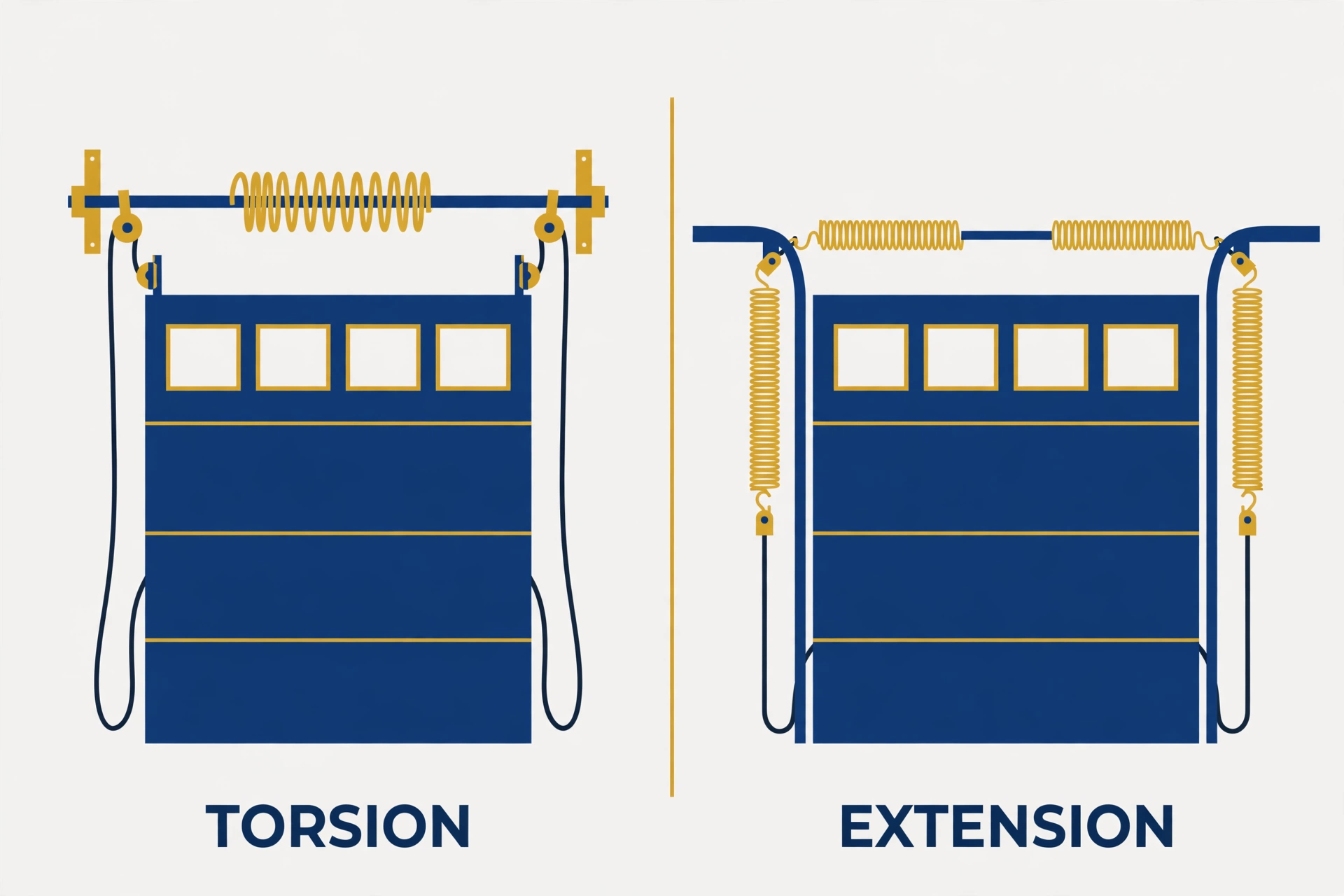
Balance comes before horsepower every time. If a door feels heavy, hangs crooked, or will not stay halfway open, no opener size will fix it, and fitting a stronger motor to an unbalanced door only hides the fault while wearing the drive out faster. The selector below therefore starts from your door and ends with the same advice a technician would give on site: check the balance first, then match the motor to the door.
Some modern openers list their force in newtons rather than horsepower. The classes in this guide still apply in plain terms — light single doors at the lower end, bigger and heavier doors a step up, and hard-working doors at the top — because what matters is the match between door and duty, not the unit on the box.
Opener sizing table: size, material, and weight to horsepower class
Use this table as general guidance. Your door's exact weight, if you know it, beats any table row, and a door that is unbalanced needs attention before any opener discussion.
| Door size | Material | Weight guide | Suggested class |
|---|---|---|---|
| Single, 8–10 feet | Plain steel | About 130–200 lbs (published band) | 1/2 HP |
| Single, 8–10 feet | Insulated steel | Heavier than plain steel of the same size | 3/4 HP |
| Single, 8–10 feet | Wood | Heavier than steel; no single published band | 3/4 HP, or 1 HP+ if heavy |
| Double, 12–18 feet | Plain steel | About 200–300 lbs (published band) | 3/4 HP |
| Double, 12–18 feet | Insulated steel or wood | Heavier than plain steel of the same size | 3/4 HP, or 1 HP+ if heavy or hard-working |
| Oversized | Any material | Above the standard bands | 1 HP+ |
| Any size | Any material, shared or commercial use | Duty matters more than weight alone | 1 HP+ |
Two patterns in the table are worth noticing. First, insulation moves a door up a class even at the same size, because the extra layers add weight the motor must handle on every cycle. Second, daily use moves a door up a class on its own: a shared or commercial door may weigh the same as a home door but cycle many times more often, so its motor needs the heavier duty rating. The selector applies both patterns for you.
Drive types compared: chain, belt, screw, and jackshaft
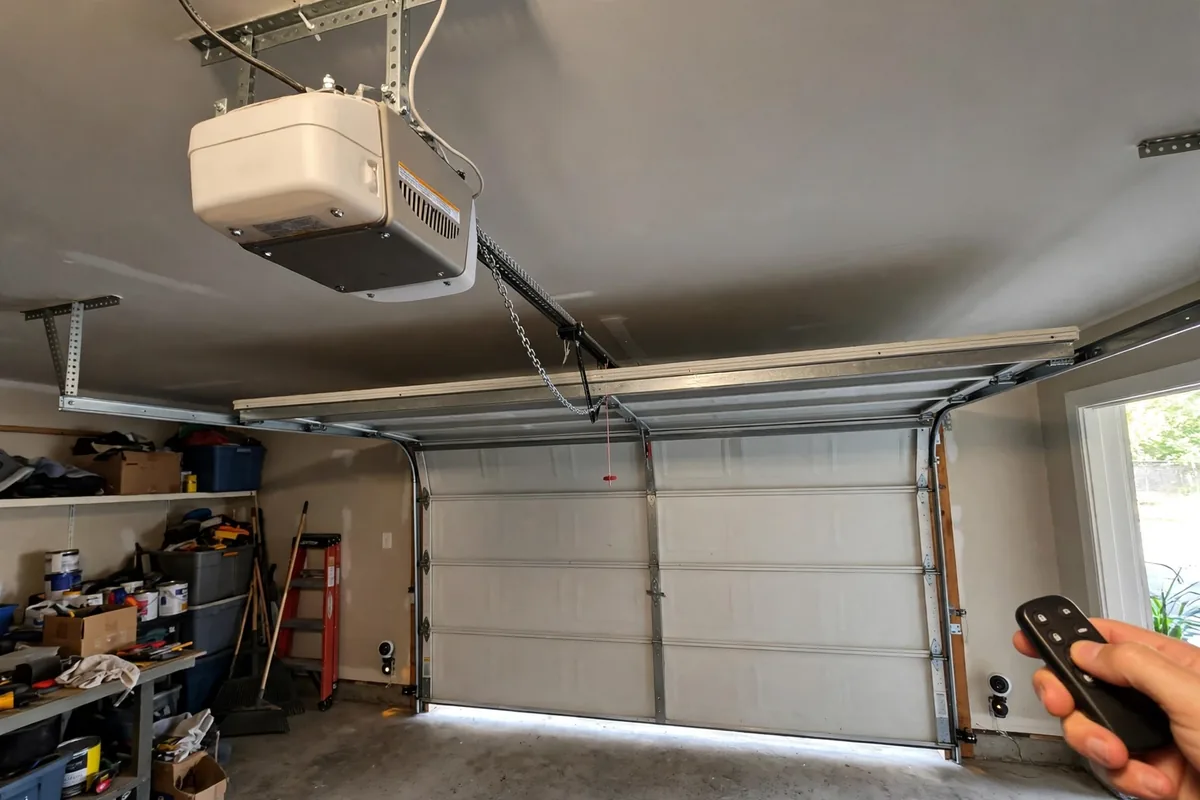
The drive is the part that moves the door along its path, and the four types differ mainly in noise, toughness, and how much ceiling space they need. None of them changes the horsepower class your door needs — that comes from size, material, weight, and use — but the drive decides how the opener sounds and fits in your garage.
Chain drive: tough, affordable, and the noisiest
A chain drive pulls the door with a metal chain, much like a bicycle chain. It is the toughest of the common drives and usually the most affordable, which makes it a solid choice for a detached garage or a heavy door where noise does not matter much. The trade-off is sound: the chain rattles and hums, and that carries through walls, so it is a poor fit for a garage with a bedroom or living room directly above or beside it.
Belt drive: the quiet choice for attached garages
A belt drive uses a reinforced belt instead of a chain, and it runs far more quietly and smoothly. If your garage sits under or beside living space, belt drive is the usual suggestion, because the opener fades into the background instead of announcing every cycle. Belts cost more than chains, but for an attached garage the quiet is the point of the purchase.
Screw drive: few moving parts, mid-range noise
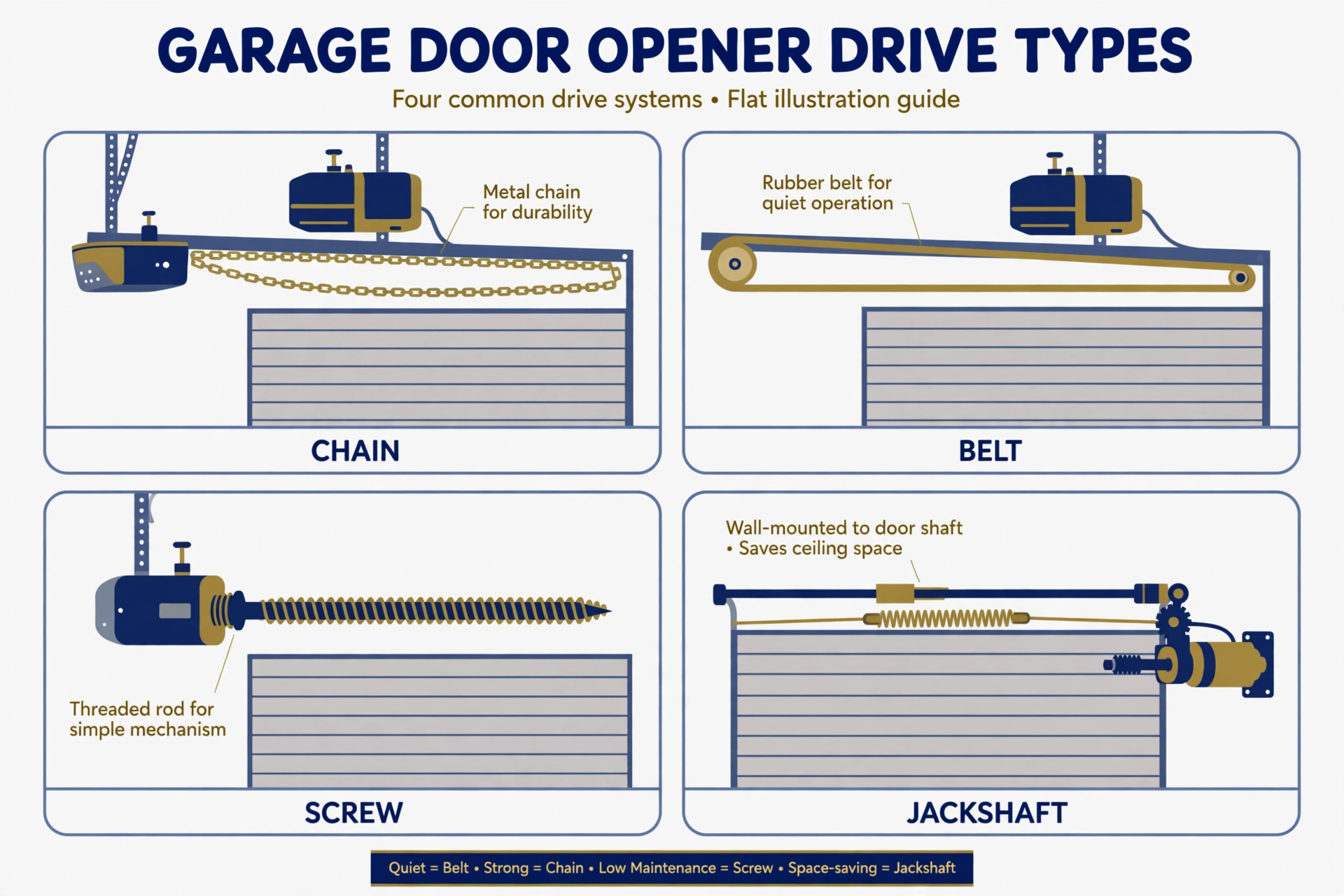
A screw drive moves the door along a threaded steel rod, with fewer moving parts than a chain or belt system. It sits in the middle on noise — quieter than a chain, louder than a belt — and it needs little maintenance beyond keeping the rod lubricated. Fewer models use this design today, so choice is narrower, but it remains a sensible middle option where quiet matters less than simplicity.
Jackshaft: no ceiling rail at all
A jackshaft, or wall-mount, opener fixes to the wall beside the door and turns the spring shaft directly, so there is no rail running across the ceiling. That frees the overhead space for storage, a car lift, or a tall vehicle, and it suits garages where headroom above the door is tight. It is the natural suggestion when the ceiling layout, rather than the door itself, rules out a standard rail opener.
For a fuller comparison of these drives, including how each one behaves on different door types, see our garage door opener types guide.
Smart features in plain terms
Smart features do not change the size your door needs, but they change how you live with the opener. Wi-Fi control lets you open, close, and check the door from your phone, and sends an alert if the door opens when you are out. A wireless keypad by the door means no remote to lose, with a code you can change. Extra remotes and a wall button cover the cars and the household. Battery backup keeps the opener working through a power cut, so you are not locked out of your own garage when the power fails. None of these features needs explaining on the call beyond which ones you actually want — the sizing conversation stays about the door.
When to replace the opener, and when to repair it
Repair is the right call when the opener itself has a single fault — a worn gear, a tired remote, a sensor knocked out of line — and the rest of the unit is sound. Replacement makes sense when faults keep coming back, when parts for an old unit are no longer available, when the safety sensors are missing or cannot be made reliable, or when the drive no longer suits the door, for example after a heavier door has been fitted. Age alone is not a verdict, but an opener that needs attention every few months is telling you the same thing a car that keeps breaking down does.
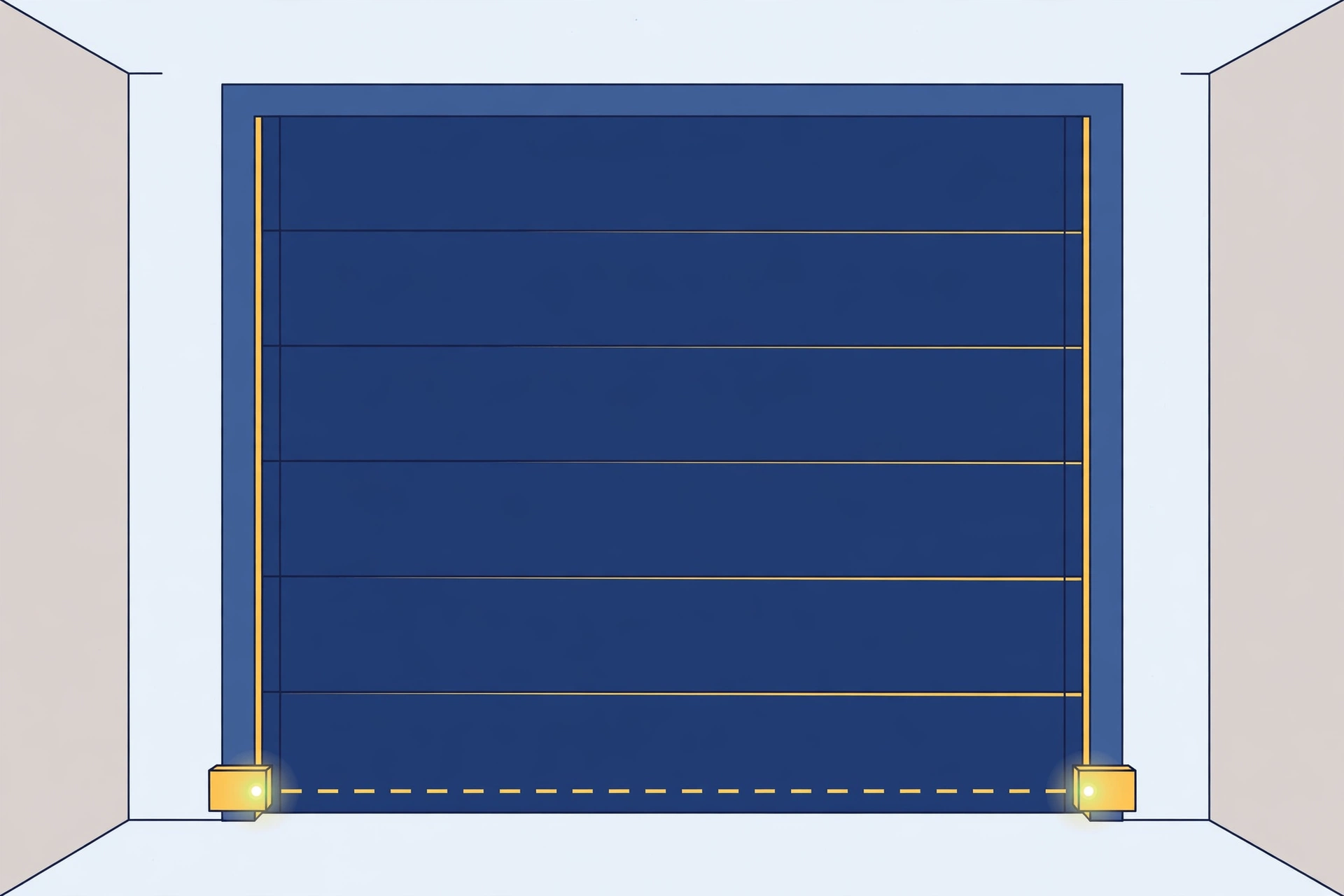
Before you call, three checks are safe for any homeowner: confirm the opener has power, try a fresh remote battery, and wipe the small sensor lenses near the floor and clear anything blocking the beam. If the door itself is heavy, crooked, stuck, or making a new loud noise, stop there and call — never touch the springs, cables, or tracks, and never try to force the door. Those checks tell us a lot on the call and cost you nothing.
If repair turns out to be the answer, our garage door opener repair service starts with diagnosis rather than a new opener quote. If the opener needs replacing, our garage door opener installation service covers matching the new unit to your door's size, weight, and balance first.
What to tell us on the call
The selector gives you the short version; the call gives you the exact one. When you ring, tell us your door's size, its material, its weight if you know it, and roughly how often it cycles each day. Add whether the garage sits under or beside living space, whether headroom above the door is tight, and what the current opener is doing — humming without moving, reversing, stopping halfway, or ignoring the remote. With those details we can tell you the next step straight away, and arrive with parts matched to your door rather than guessing. For the full picture of what we cover across the state, start from the Bay State Garage Door Repair Pros homepage, and for a wider look at drive types, the opener types guide linked above is the companion to this page.
Ready to talk it through? Call (833) 563-1552, Monday to Saturday, 9:00 AM to 6:00 PM, and tell us your door's size and material for a clear next step. You can also browse our other free garage door tools and our garage door safety sensors guide for the sensor checks every opener owner should know.
Frequently asked questions about garage door opener size
What size opener do I need for a double garage door?
As general guidance, a standard double steel door suits a 3/4 HP opener, because the wider door puts more strain on the drive than a single door. Insulated or wood doubles, and any double door that cycles many times a day or serves a shared garage, step up to the 1 HP+ class for the heavier duty rating. Tell us your door's material and weight on the call for a clear next step.
Is a bigger horsepower opener always better?
No. A bigger motor on a light, well-balanced door adds cost without adding benefit, and it never fixes the real fault when a door is heavy or unbalanced — that is a spring and balance problem, not a power problem. The right size is the class matched to your door's size, material, weight, and daily use, so the motor works within its design on every cycle instead of straining or idling. Matching beats oversizing, every time.
How can I find out how much my garage door weighs?
Check the label on the inside of the door, the paperwork that came with it, or the manufacturer's specification for that model — those are the reliable sources. Do not try to judge it by lifting the door or by disconnecting anything, and never touch the springs, cables, or tracks to find out. If you cannot find a weight, the selector estimates from size and material instead, and tells you it is an estimate.
Will a new opener fix a heavy or unbalanced door?
No. The springs carry nearly all the weight, so balance is checked first — an opener never fixes a bad spring. A door that feels heavy, hangs crooked, or will not stay halfway open needs its spring system and balance looked at before any opener discussion, because fitting a stronger motor to an unbalanced door only hides the fault while wearing the new drive out faster. Fix the balance, then match the opener.
Chain, belt, or jackshaft — which suits a garage with a bedroom above it?
Belt drive is the usual suggestion there, because it runs far more quietly than a chain drive, whose rattle carries through walls and floors. Chain drive suits a detached garage or a heavy door where noise matters less and toughness matters more. Jackshaft is a different question altogether: choose it when headroom above the door is tight or you want the ceiling space free, since it mounts on the wall with no ceiling rail.
Get help choosing your opener size
Call (833) 563-1552, Monday to Saturday, 9:00 AM to 6:00 PM, with your door's size and material, and we will give you a clear next step.