
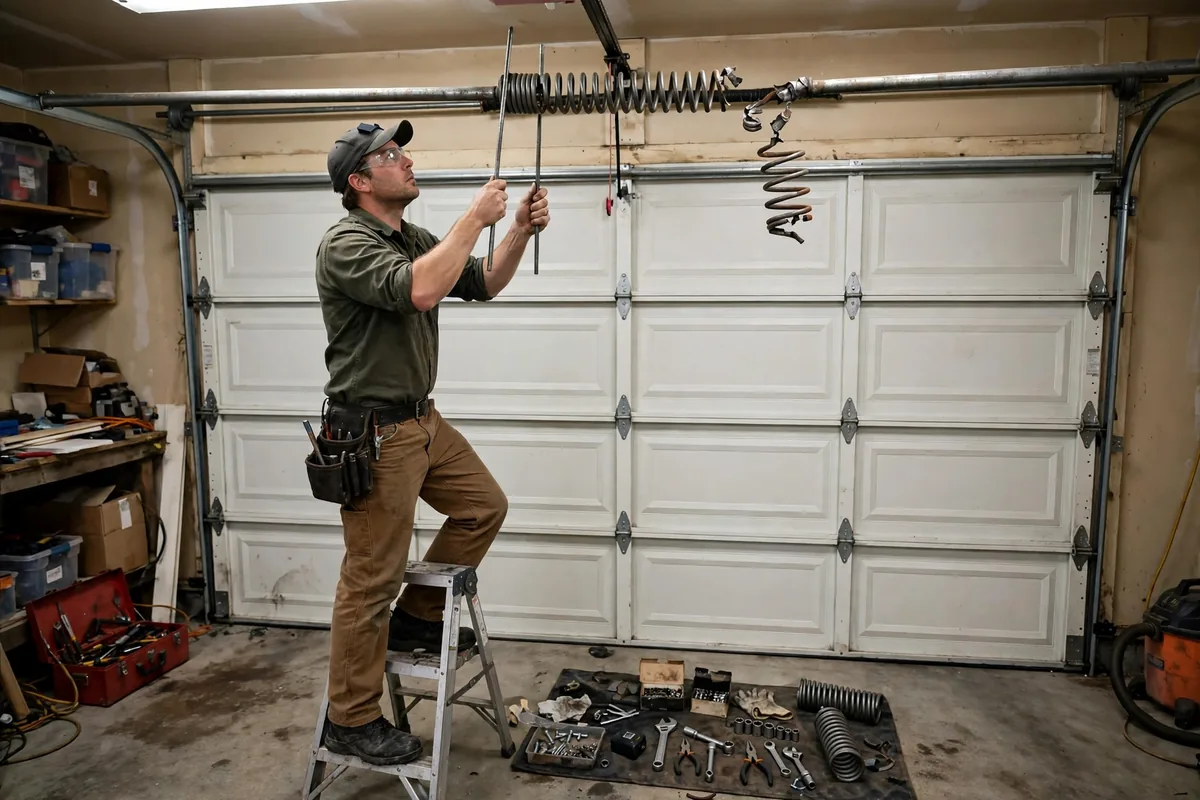
A broken spring, a snapped cable, and a dead opener can look alike from the driveway. This free checker, from Bay State Garage Door Repair Pros, matches what your door is doing to a likely fault and a short list of details to report. For the repair itself, see our garage door spring replacement service.
Use the spring fault checker
Tick every symptom you have, tell us the spring type if you know it, and say where the door is stuck. Then press the button for a likely fault and what to report on the call. The checker is free to use and collects nothing you enter.
Please tick at least one symptom before checking.
Your likely fault
Do not pull the emergency release cord and try to lift a door with a broken spring. Leave it closed and call us.
What to tell us on the call
This checker gives a likely fault, not a diagnosis and not a price. A technician confirms the fault on site.
How a garage door spring carries the door
A garage door is far heavier than it feels when it works properly, and the spring is what makes it feel light. The spring stores the energy that balances the door's weight, so the opener only has to guide the door up and down rather than haul its full weight. When that balance is gone, the door becomes heavy, slow, or stuck, and the opener strains against a load it was never built to carry alone.
Most homes have one of two spring layouts. A torsion setup uses a coiled spring on a bar above the door opening; as the door closes, the spring coils tighter and stores energy, then releases it to help open the door. An extension setup uses a pair of springs along the horizontal tracks on each side; they stretch as the door closes and contract to pull it open. Both do the same job in a different place, and both wear out with use.
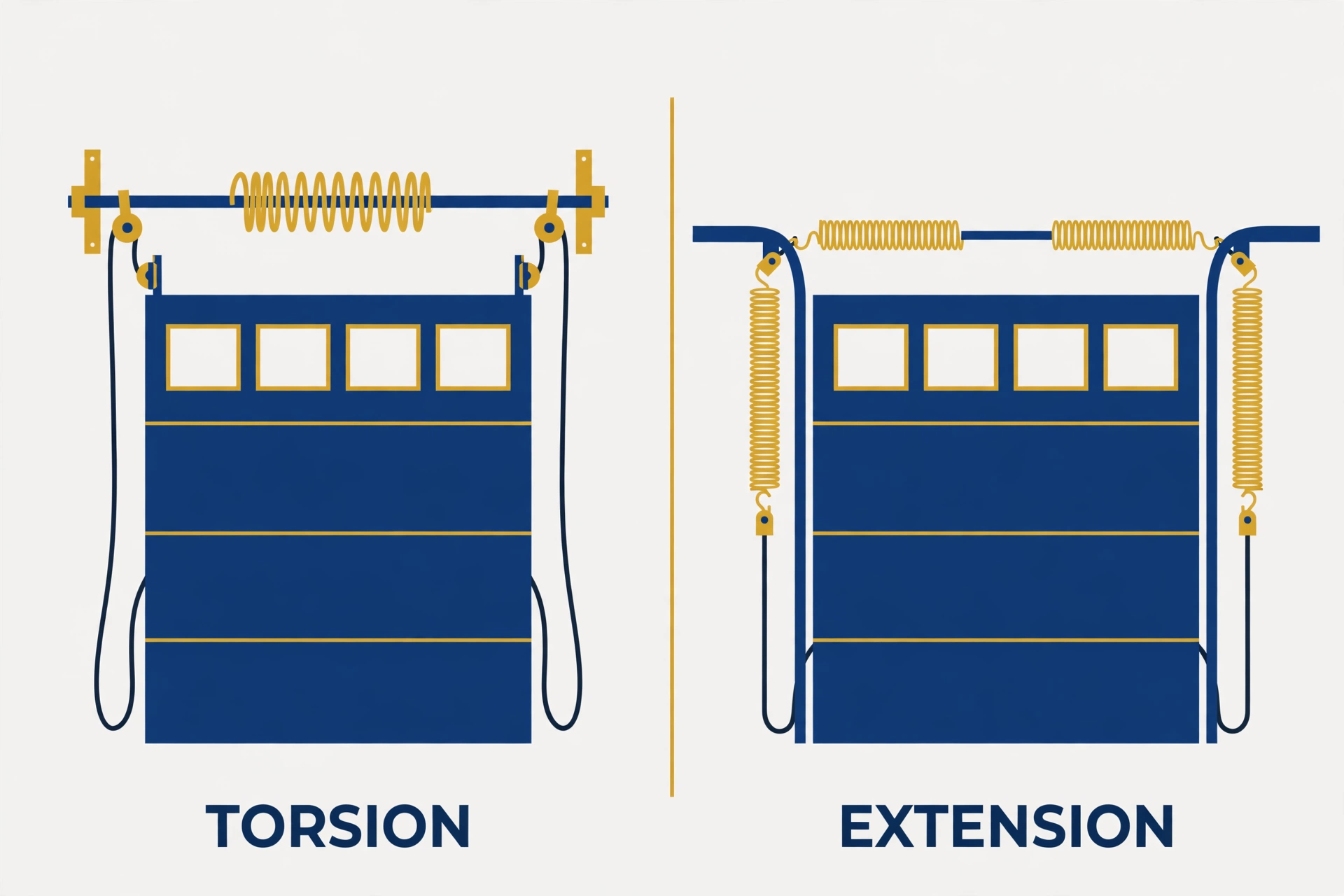
You can usually tell which layout you have by looking, without touching anything. Stand inside the garage with the door closed and look above the opening: a long coiled spring on a bar means a torsion setup. Look along the tracks instead and you may see a spring stretched on each side, which means extension springs. If you cannot see either clearly, or you are unsure, say so on the call — identifying the layout is part of the visit, and you should never climb, reach into the mechanism, or move parts around to get a better look.
The classic signs of a broken spring
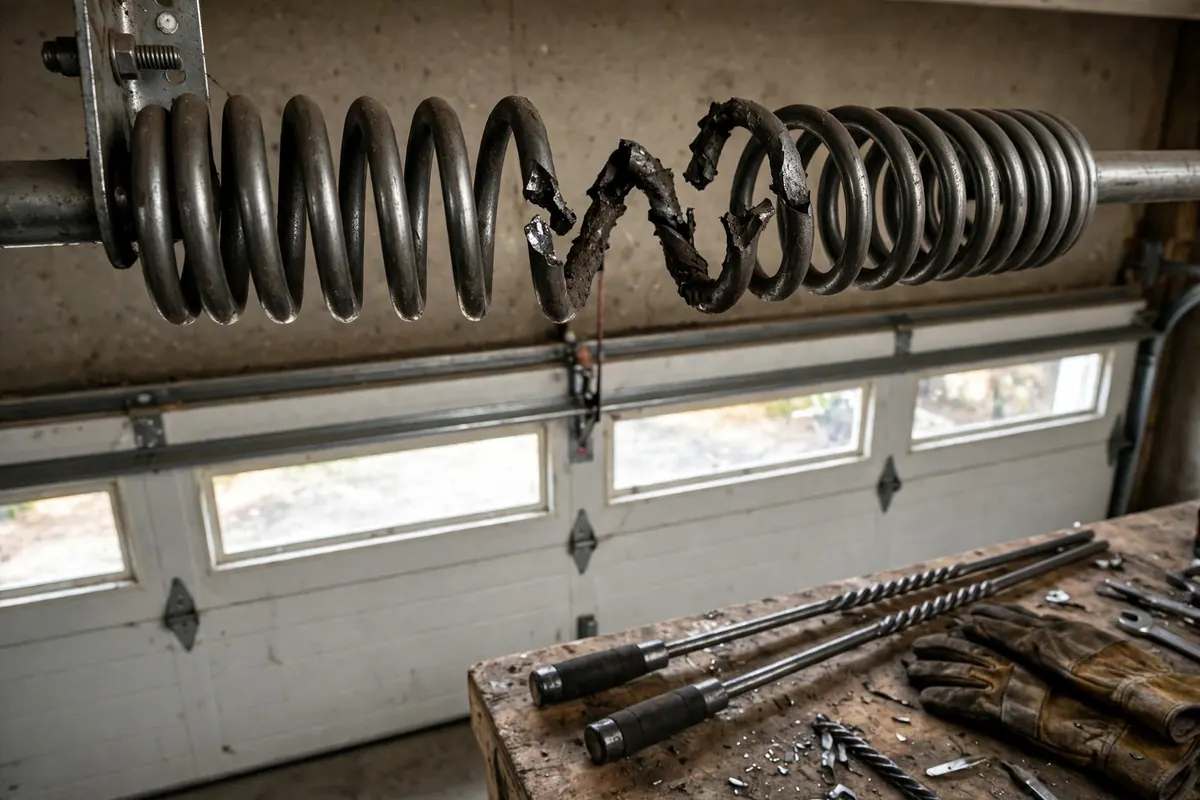
The most famous sign is also the most reliable: a sharp bang from the garage, like something heavy snapping, followed by a door that suddenly feels far too heavy or only opens a few inches before stopping. That bang is the spring breaking, and the heaviness that follows is the door's full weight coming back all at once. If that pair of symptoms shows up together, treat the spring as broken until a technician says otherwise.
Other signs build the same picture more quietly. A visible gap in the coil above the door, a door that closes too fast or slams, a door that opens unevenly, or an opener that hums and strains without moving the door can all point to a spring that has lost its strength. Springs do not always fail with drama; sometimes the door just gets heavier week by week as the spring weakens, until one day it will not open at all. The response is the same: stop using the door, keep the area clear, and call.
One warning matters more than the rest. A door with a broken spring is not a door you can muscle open and deal with later. Without the spring balancing it, the door can drop suddenly, and forcing it can bend the tracks, damage panels, or burn out the opener. Leave the door where it is, do not run the opener at it repeatedly, and keep children and pets away from it until help arrives.
Why spring work is a technician-only job
A garage door spring holds a large amount of stored energy. That energy is what lifts a heavy door with one hand when everything works, and it is also what makes a broken or mishandled spring dangerous. A spring that slips, or a door that drops while someone is working under it, can cause serious injury in a second. This is the one garage job where saving a service call is never worth the risk, and it is why this site never explains how to handle, adjust, or replace a spring.
A few safe checks never involve the springs, cables, or tracks. You can check that the opener has power, replace a remote battery, wipe dust from the small photo-eye sensors near the floor, and clear an obvious obstruction from the doorway. If the problem clears, it was never a spring problem. If it does not, or if the door is heavy, crooked, or stuck, stop there and call.
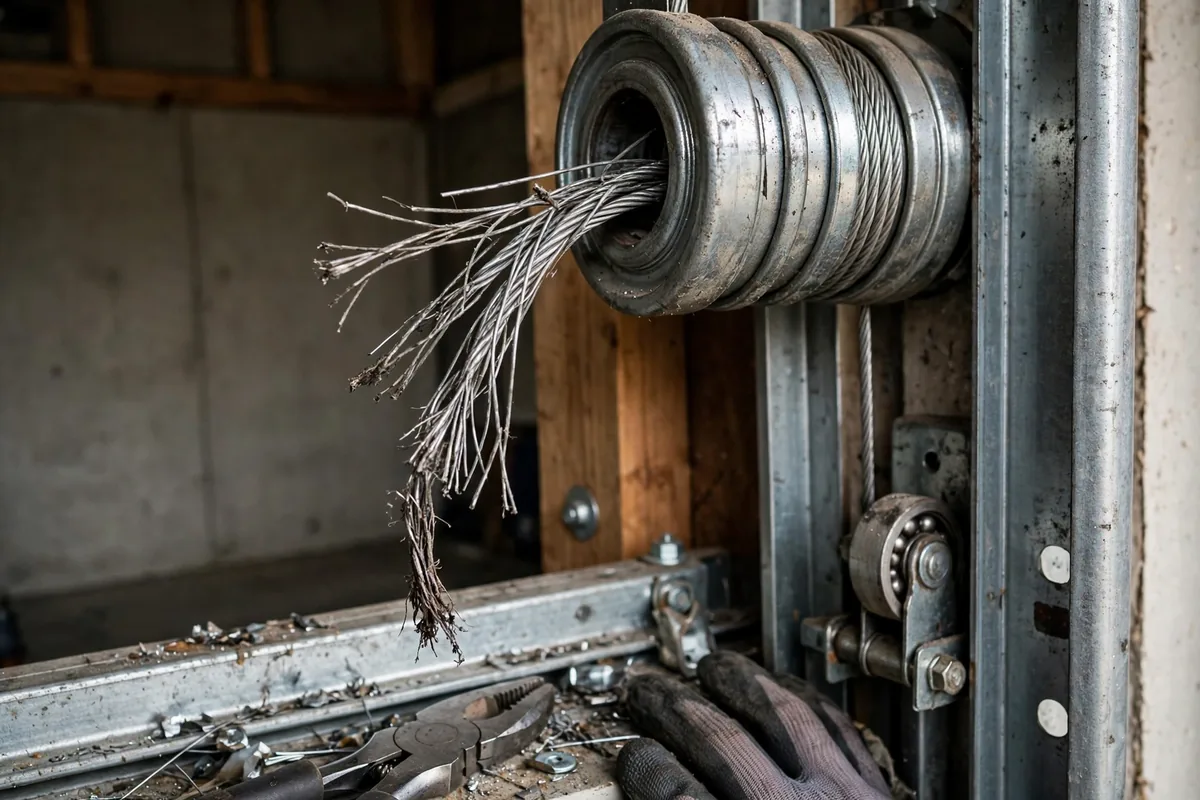
The same rule covers the parts around the spring. Cables work under the same tension as the springs, and tracks guide a heavy door that can shift without warning. A frayed cable, a bent track, or a roller that has come loose all sit in the same do-not-touch group. Describing what you see on the call is helpful; reaching in to fix it is not.
Spring, cable, or opener? Telling the faults apart
Three faults cause most garage door trouble, and their symptoms overlap enough that a careful comparison helps. A broken spring gives you the bang and the sudden heaviness. A snapped or frayed cable gives you the crooked door, one side dropping, or a cable visibly hanging loose. An opener or sensor problem gives you a door that ignores the remote, reverses for no clear reason, or only moves while you hold the wall button down. The table below lines those patterns up so you can see which one your door matches.
| What the door does | Most likely fault | What it means |
|---|---|---|
| Loud bang, then the door feels very heavy | Broken spring | The spring that balanced the door has failed, and the door now carries its full weight. |
| Door hangs crooked, or one side drops | Snapped or frayed cable | A cable has failed on one side, so the door no longer lifts evenly. |
| Door ignores the remote or keypad | Opener or sensor problem | Power, the remote, the keypad, or the photo-eye sensors need checking before anything else. |
| Door reverses, or only moves while you hold the button | Opener or sensor problem | A blocked or misaligned sensor, or an opener setting, is stopping normal travel. |
| New grinding or scraping as the door moves | Needs hands-on diagnosis | Rollers, track alignment, or opener gears could each be the cause, and only a look on site separates them. |
| Bang together with a crooked door | Needs hands-on diagnosis | Spring and cable faults can cause this pair together, so a technician confirms which failed. |
Two cautions keep this comparison honest. A door can have more than one fault at once — a broken spring can strain a cable, and a failing cable can throw a door off its tracks. And the table gives a likely fault, not a diagnosis; if your symptoms match two rows, or none cleanly, the honest answer is a hands-on look.
Opener problems deserve one extra note, because they are the easiest to misread. A door that will not respond to the remote is not automatically a broken spring, and a spring problem will not be fixed by a new remote. Check power, the remote battery, and whether anything blocks the small sensors near the floor first. If those checks change nothing, the fault is deeper than the remote, and the next step is a visit, not a replacement part bought on a guess. For the repair itself, see our garage door cable repair service and our garage door opener repair service.
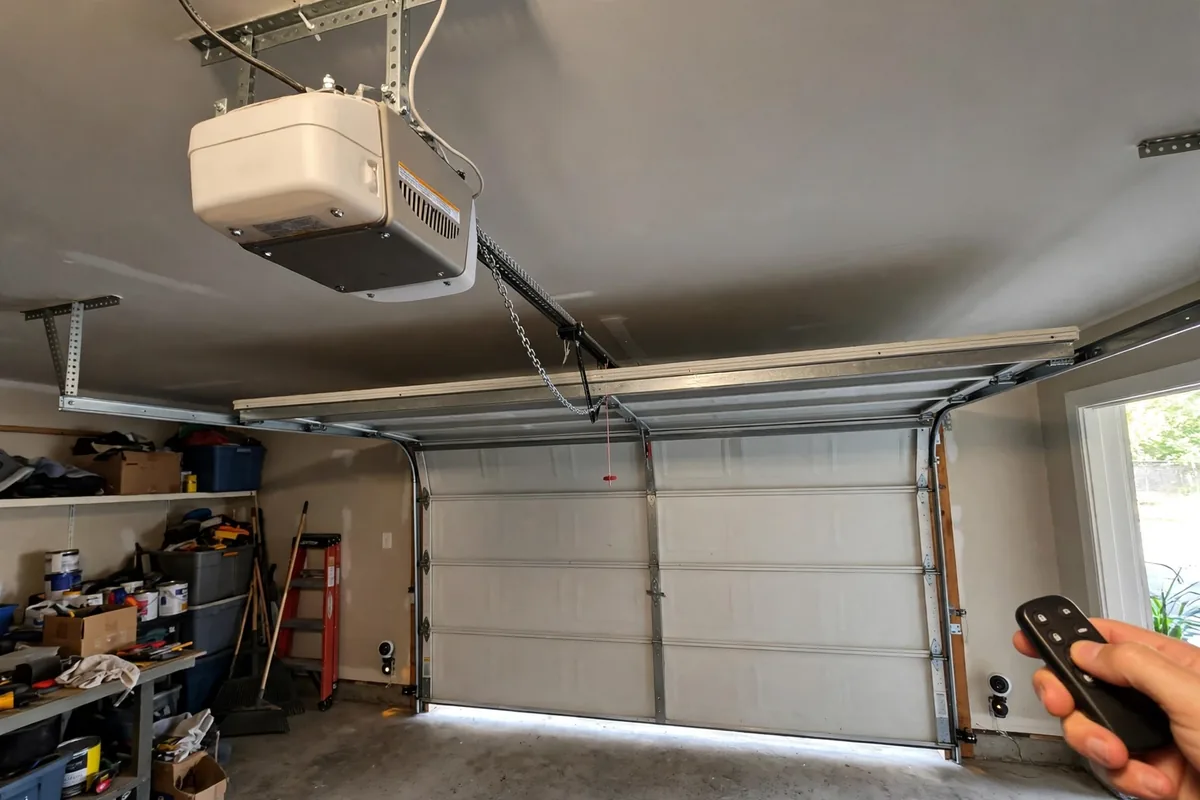
What a spring visit covers
A spring visit starts with diagnosis, not parts. The technician looks at the door, the spring layout, the cables, the rollers, and the opener together, because those parts wear as a system and a fault in one often strains another. That whole-system look is what separates a repair that lasts from a part swapped onto a door that will fail again next month.
Once the fault is confirmed, the replacement spring is matched to your door's weight and size, fitted, and balance-tested so the door sits level and moves smoothly by hand and under the opener. Cables, drums, rollers, and safety sensors are checked at the same time, and the opener's force and sensor settings are tested before anyone leaves. Most single spring replacements take one to two hours on site once the correct spring is in hand; a pair replacement, or a job that also needs cables or rollers, can take longer.
If both springs serve the door and one has broken, ask on the call whether replacing the pair makes sense. Springs fitted together have shared the same cycles, so the second often follows the first — but the right call depends on what the technician finds on site.
What to tell us when you call
A few details on the call save a wasted visit and help us arrive with the right parts. Tell us your door's rough size and whether it is a single or double door, the spring type if you know it, every symptom you noticed and when it started, and whether the door is stuck open, closed, or halfway. Mention anything about access, such as a car trapped inside or a door stuck open that you cannot secure, because that changes how urgently the visit is arranged.
If you used the checker above, read out its result and the symptoms you ticked — that is exactly the information it was built to collect. And if you do not know the spring type, or you are unsure about any symptom, say so plainly. A clear “I do not know” helps more than a guess, and identifying the layout is part of the visit. For a deeper explanation of the two layouts, read our garage door spring types guide, and see our other free garage door tools.
Frequently asked questions about the garage door spring fault checker
Does this checker tell me which spring to buy?
No. The checker only matches your symptoms to a likely fault — a broken spring, a snapped cable, or an opener problem. It never gives a spring size, a part number, or an order recommendation, because the right part depends on your door's weight and size, which a technician confirms on site. Use the result to describe the problem on the call, not to buy parts.
Can I open my garage door if the spring is broken?
You should not try. Without a working spring, the door carries its full weight, and it can drop suddenly or damage the opener if you force it. Leave the door closed, keep the area clear, and call (833) 563-1552 for help during our hours. If the door is stuck open and you cannot secure it, say so first on the call so we can advise you on the safest next step.
How do I tell a broken spring from a snapped cable?
A broken spring usually announces itself with a loud bang, then a door that feels far too heavy or only opens a few inches. A snapped or frayed cable more often shows as a door that hangs crooked or drops on one side, sometimes with a cable hanging loose. The two faults overlap, so when the signs point both ways, the checker says so and a technician confirms the fault on site.
What should I tell you when you call?
Tell us your door's rough size, whether it is a single or double door, the spring type if you know it, every symptom you noticed, and whether the door is stuck open, closed, or halfway. Those details help us bring the right parts on the first visit and give you a clear next step on the call. If you do not know the spring type, say so — that is normal, and it is part of what we check.
Is the spring fault checker free to use?
Yes. The checker is free to use, and it does not collect, store, or send anything you enter — your answers stay in your browser and disappear when you leave the page. It gives a likely fault, not a diagnosis and not a price. A technician confirms the fault on site and confirms your exact price there before work starts.
Not sure what your door is doing? Call us
A broken spring, a snapped cable, or a dead opener does not have to mean a day stuck at home. Call Bay State Garage Door Repair Pros at (833) 563-1552, Monday through Saturday, 9:00 AM to 6:00 PM. Describe what your door is doing, and we will give you a clear next step.
Last updated: November 2, 2026. Author: Jude Bray, Bay State Garage Door Repair Pros. Business address: 98-2 Ames Pl, Lowell, MA 01851. Phone: (833) 563-1552. Email: [email protected]. This checker is free to use. It does not collect, store, or send anything you enter. Images and diagrams on this page are illustrations, not photos of real jobs or real staff.