
Find your garage door size in two minutes
Measure the opening, not the old door. Enter the numbers below and the finder matches the nearest standard size, checks your headroom and sideroom, and works out the backroom you need. The tool is free to use, it stores nothing, and it sends nothing anywhere. For the next step after measuring, start from our Bay State Garage Door Repair Pros homepage or call with your numbers.
Enter your measurements
General industry guidance only — the result is a starting point for the call, not a guarantee for a specific door. Final fit is confirmed on site.
How to measure your garage opening, step by step
Use a steel tape measure, measure from inside the garage, and keep the door closed while you work. You are measuring the finished opening — the hole the door fills — not the old door slab, and not the trim around it. Write each number down as you go, and measure twice before you trust a number that looks odd. Do not touch springs, cables, drums, or tracks to take these measurements; everything here is measured on the frame, the floor, and the walls, with your hands well clear of the moving parts.
Start with the width. Measure inside the frame, jamb to jamb, at three heights: near the floor, at the middle, and near the top. Openings are rarely perfect, especially in older houses where frames settle and walls lean a little. The smallest of the three numbers wins, because the door has to fit the tightest point, not the widest. Do the same for the height: floor to the underside of the header, on the left, in the middle, and on the right, and again take the smallest number. If two measurements disagree by more than an inch, measure a third time and check whether the tape is sitting square across the opening rather than at an angle.
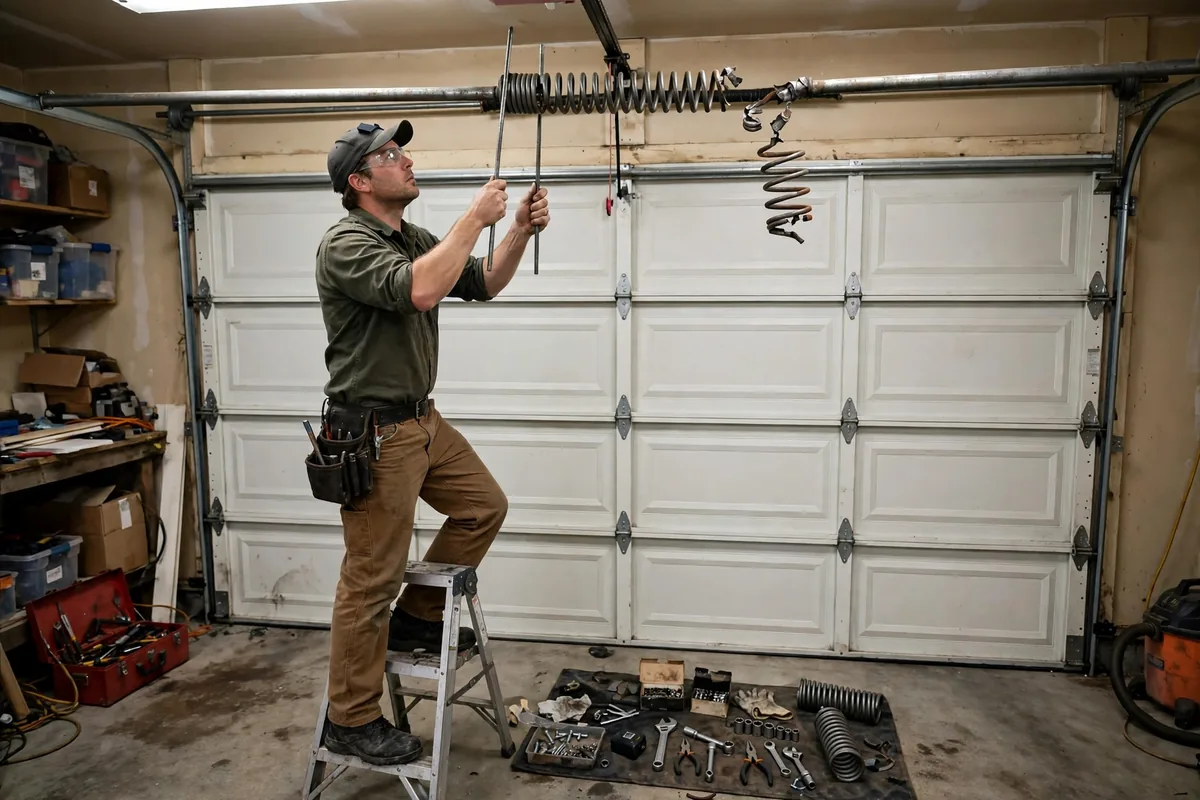
Next, headroom. Stand inside, look at the top of the opening, and measure straight up to the lowest thing above it — a ceiling joist, a beam, a pipe, a duct, or the garage ceiling itself. Whatever hangs lowest is your headroom, because the horizontal tracks and the opener rail have to live in that space. Then sideroom: on each side, measure from the edge of the opening to the nearest wall or obstruction. Measure both sides separately, because garages are often tighter on one side than the other, and the tight side decides what track hardware fits. Finally, backroom: measure from the opening straight back into the garage to the nearest obstruction, such as a back wall, a parked car position, or shelving. The finder works this one out for you from the door height, but a tape check against the real space is always worth doing.
Standard garage door sizes
Most residential garage doors are built to a short list of standard sizes, and the table below covers the common ones. Single-car openings are usually 8, 9, or 10 feet wide; double-car openings are usually 12, 14, 16, or 18 feet wide; heights are usually 7 or 8 feet. The finder rounds your measurements to the nearest size on this list. If your opening lands more than about 3 inches from the nearest standard size, or outside the list entirely, the finder says so plainly: that opening likely needs a custom-size door, and the exact fit is confirmed on site.
| Opening type | Standard widths | Standard heights |
|---|---|---|
| Single-car door | 8 ft, 9 ft, 10 ft | 7 ft, 8 ft |
| Double-car door | 12 ft, 14 ft, 16 ft, 18 ft | 7 ft, 8 ft |
Older houses are the usual exception. A garage built before standard sizes settled, or one that was altered when a carport was enclosed, can easily sit an inch or two off the list, and that is normal — it does not mean the opening is wrong, only that the door is made to fit it rather than the other way round. Makers also vary slightly in real dimensions, so two doors both sold as 9 by 7 feet can differ by a fraction of an inch. That is why the finder talks about the nearest standard size plus a site confirmation.
Headroom, sideroom and backroom, explained
Headroom decides whether standard tracks fit. As general industry guidance, standard horizontal tracks need about 12 to 15 inches of clear space above the opening. If your headroom is at least 15 inches, standard tracks should suit. Between 12 and 15 inches you are at the low end of that range, so the fit needs confirming on site. Below 12 inches, standard tracks usually will not fit, and a low-headroom kit may be needed — a different track arrangement that hugs the ceiling more closely. Measure to the lowest obstruction, not to the ceiling boards, because a single beam or pipe can take several inches off the space the tracks actually have.
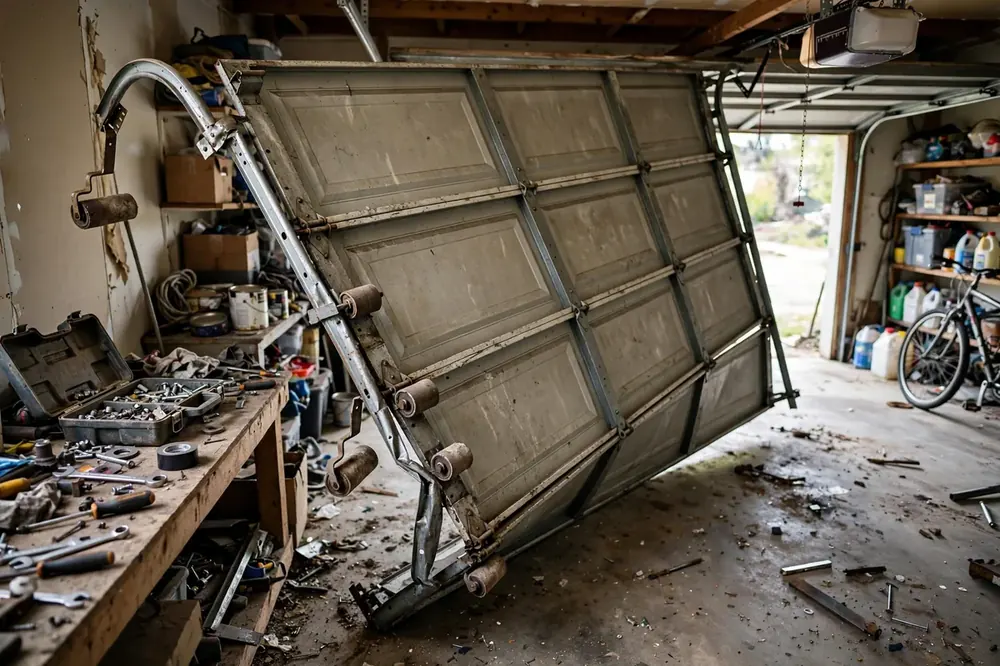
Sideroom is the space beside the opening that the vertical tracks occupy. Standard vertical tracks need about 3.75 to 5 inches of clear sideroom on each side, as general guidance. Five inches or more on both sides suits standard tracks. Between 3.75 and 5 inches is tight and needs confirming, because the track, its fasteners, and the door's edge clearance all have to share that strip. Below 3.75 inches on either side, standard tracks may not fit at all, and special track hardware may be needed. The tight side matters most: a garage with 8 inches on the left and 3 inches on the right is a 3-inch sideroom garage for fitting purposes.

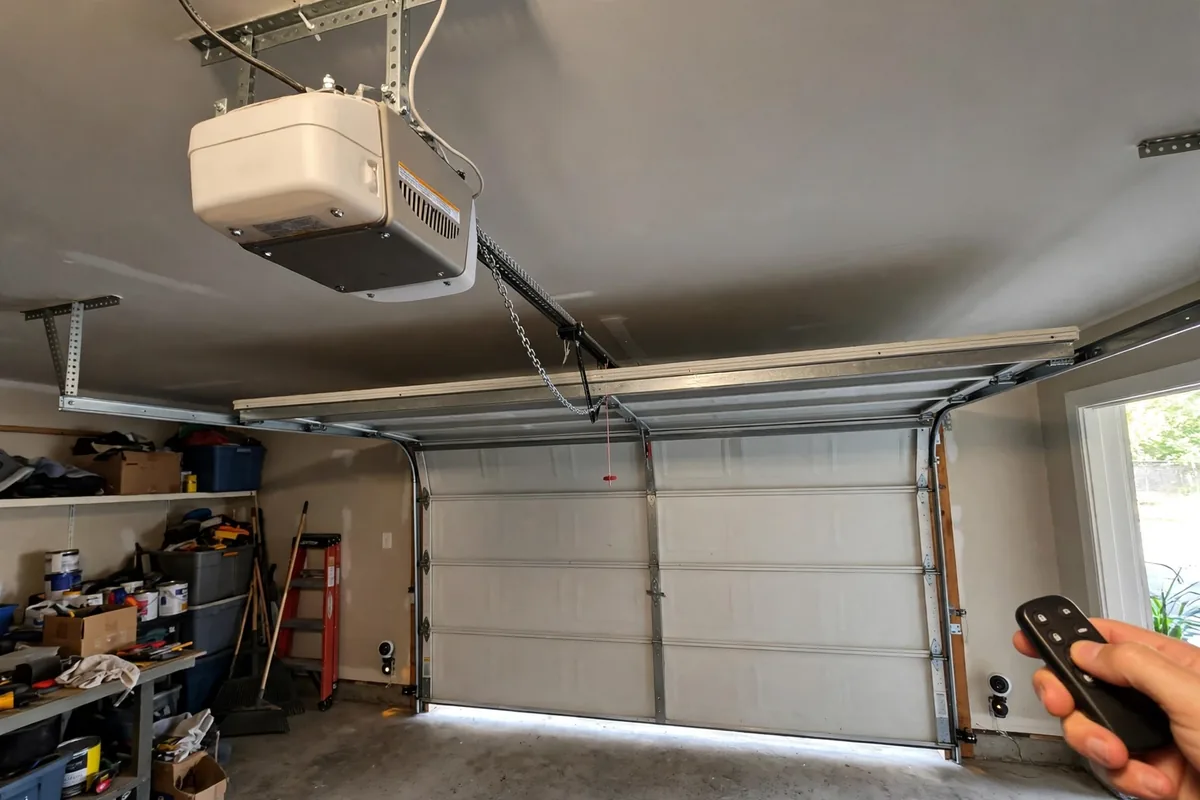
Backroom is the depth the door needs when it opens. A sectional door travels back horizontally along the ceiling, so the garage must be deep enough to hold the whole door flat overhead. As a rule of thumb, allow the door height plus about 18 inches, and more again if an opener is fitted, because the opener rail and motor extend past the end of the horizontal tracks. A 7-foot door therefore needs roughly 8 feet 6 inches of clear depth before an opener is counted, and an 8-foot door roughly 9 feet 6 inches. If shelving, a back wall, or a car in its usual spot eats into that depth, say so on the call — it changes what fits.
Single, double, tall and RV openings
A single-car opening serves one car, and the usual widths are 8, 9, or 10 feet. Eight feet suits a smaller car and a tighter garage; 9 feet is the common middle ground; 10 feet gives comfortable room to open car doors inside the garage. A double-car opening serves two cars side by side, usually 12, 14, 16, or 18 feet wide. Sixteen feet is the familiar double width, while 18 feet suits wider vehicles or a garage where two cars need proper door-opening room. Some double garages were built as two single openings with a post between them rather than one wide opening — if yours has a centre post, measure each opening separately, because each side is its own door size.
Tall openings are usually about height, not width. An 8-foot-high door suits taller vehicles and garages with high ceilings, and it is a standard height on the list above. Anything taller than 8 feet — a tall truck, a camper, or an RV bay — usually falls outside the standard list and into custom sizing, because the door, the tracks, and the opener all have to be made for that height. If your opening is taller than 8 feet, enter the real number in the finder rather than rounding it down: the finder will flag it as outside the standard range, and that flag is useful information for the call, not a problem. For background on choosing between door types once the size is known, see our garage door insulation guide and our garage door installation service page.
When a custom size makes sense
A custom size makes sense whenever the opening does not match the standard list. That happens with older openings that were built before sizes settled, with openings altered during an extension or a conversion, with taller-than-standard bays, and with openings that sit between two standard sizes. A custom door is made to the opening's real measurements, so it fits the tightest point rather than leaving a gap or needing the frame altered. The trade-off is time and price: a made-to-order door takes longer to arrive than a stock size, and the exact price depends on the door, so it is confirmed on site rather than guessed from the finder. If the finder flags your opening as between sizes or outside the standard range, treat that as the start of the conversation, not a dead end — call with the numbers and ask what a custom fit would involve.
One more case: an opening on a standard size can still need non-standard track hardware if headroom or sideroom is poor. That is why the finder reports clearance notes alongside the size, and why the call should always include those two numbers. For panel and hardware questions once the size is settled, our garage door panel replacement service page explains how panels are matched to the existing door.
What to tell us on the call
Five numbers and one fact cover almost everything: opening width, opening height, headroom, sideroom on each side, and whether an opener is fitted or wanted. Read them straight from your tape notes, smallest numbers included — do not round them to the nearest foot before calling, because the rounding is where fit problems hide. Add anything unusual you noticed while measuring: a beam that cuts into the headroom, a side wall that is tight on one side only, a centre post, shelving that limits backroom, or a door that is taller than 8 feet. If you already ran the finder, tell us the size it suggested and any flag it raised, such as between sizes or low headroom. That gives a clear next step on the first call instead of a second visit to re-measure. If the door itself is faulty rather than just the wrong size, our garage door opener installation service page covers opener fits, and the tools hub will gather this finder with future tools as they are published.
Frequently asked questions about garage door sizes and measuring
Do I measure the door or the opening?
Measure the opening, inside the frame, jamb to jamb for width and floor to header underside for height. The old door slab can be warped, replaced, or slightly off size, so it is a poor guide. Take three measurements for each dimension and keep the smallest, because the new door has to fit the tightest point, not the average.
What if my opening falls between two standard sizes?
It likely needs a custom-size door made to your opening's real measurements, and the finder will say so. That is common in older houses and altered garages, and it is not a problem — it only means the door is ordered to fit rather than taken from stock. Call with your exact numbers so the fit can be confirmed on site.
How much headroom do I need above the opening?
As general guidance, standard tracks need about 12 to 15 inches of clear headroom above the opening. At 15 inches or more, standard tracks should suit. Between 12 and 15 inches you are at the low end and the fit needs confirming. Below 12 inches, a low-headroom kit may be needed, so measure to the lowest beam, pipe, or duct, not just the ceiling.
Can I measure with the door closed?
Yes, and that is the safest way. Measure from inside the garage with the door closed, using only the frame, floor, and walls. Do not touch springs, cables, drums, or tracks, and do not pull the emergency release to measure. If anything about the door looks broken or under strain, stop measuring and call instead.
Will the nearest standard size always fit my opening?
Not always. The nearest size is a starting point, but headroom, sideroom, backroom, and obstructions can change what actually fits, and makers vary slightly in real dimensions. That is why the finder pairs every size result with clearance notes, and why final fit is always confirmed on site before work starts.
Measured your opening? Call Bay State Garage Door Repair Pros at (833) 563-1552, Monday through Saturday, 9:00 AM to 6:00 PM, with your width, height, headroom, and sideroom numbers for a clear next step.
Last updated: November 2, 2026. Author: Jude Bray, Bay State Garage Door Repair Pros. Business address: 98-2 Ames Pl, Lowell, MA 01851. Phone: (833) 563-1552. Email: [email protected]. Tool measurements are general industry guidance; final fit is confirmed on site.