
Garage Door Insulation Guide for Massachusetts Homes
This garage door insulation guide for Massachusetts explains R-value in plain language, compares single, double, and triple layer construction, and shows when insulation alone is worth it, and when a new door makes more sense for your home instead.
For most attached Massachusetts garages, an insulated door in the R-10 to R-13 range is the sensible baseline, with higher values for heated garages or rooms above the garage. For a detached garage used only for parking, insulation matters far less, and a basic uninsulated door is often fine.
R-value explained: what the number actually measures
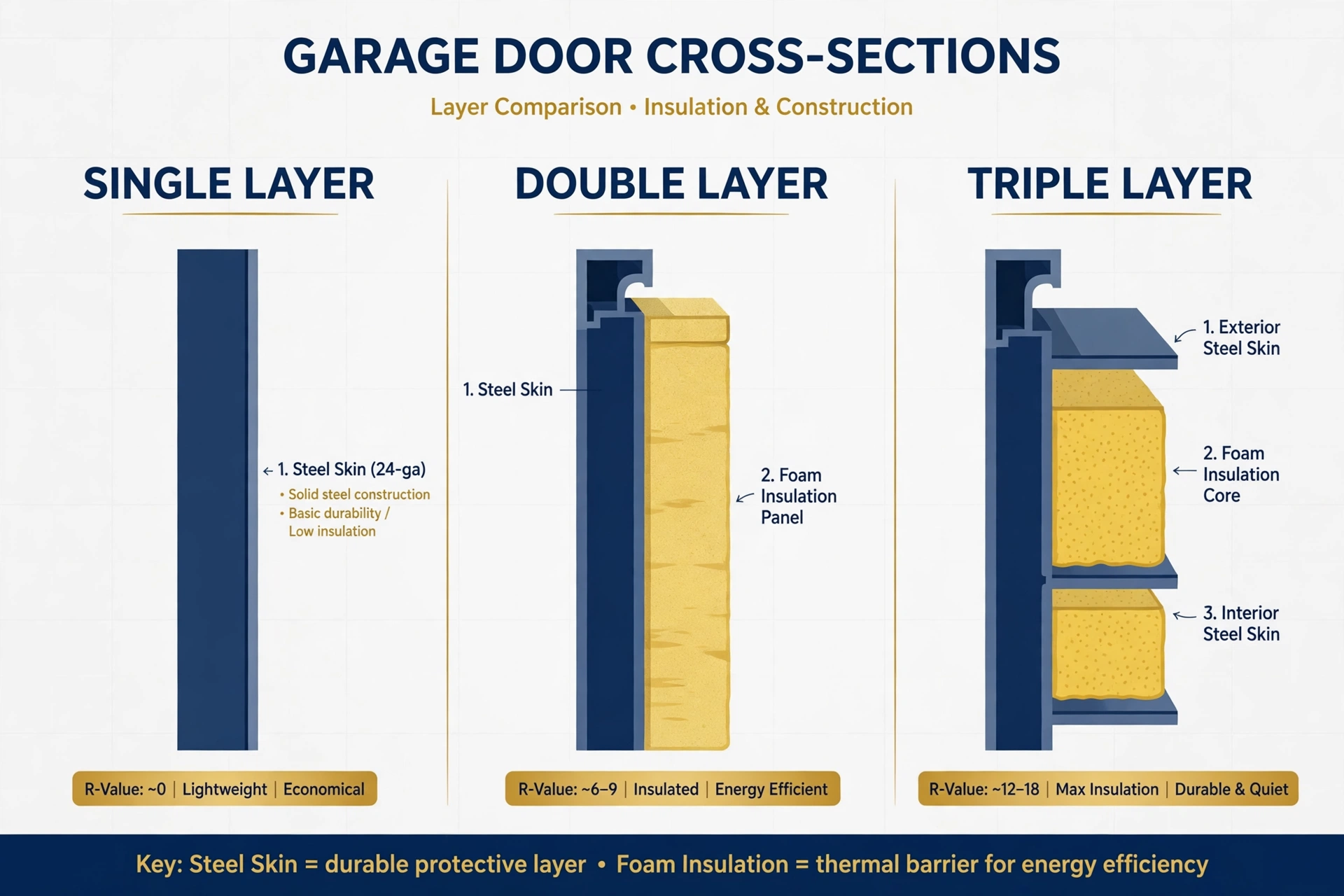
R-value measures how well a material resists the flow of heat. A higher number means better insulation: heat passes through more slowly, so the garage stays closer to the temperature you want. An uninsulated single-layer steel door has essentially no R-value, rated around R-0 in the buying guides. Insulated residential doors commonly range from about R-6 to R-18, depending on construction and foam type.
One detail that trips people up: an R-value usually describes one door section, not the whole installed door. The finished door also leaks air around its edges, between sections, and under the bottom seal. A door rated R-16 with a torn bottom seal and gaps at the sides will still let cold air straight in, which is why sealing matters as much as the headline number. When you compare doors, ask for both the section R-value and what sealing the door has between sections and at the floor.
For cold climates, manufacturer guidance published by Clopay puts the target at R-10 to R-13, with R-15 or higher for extreme regions or heavily conditioned spaces. That range is a useful anchor for Massachusetts: most attached garages sit comfortably in it, and going far beyond it brings diminishing returns unless the garage is heated or lived in. A detached garage used only for parking does not need to chase those numbers at all.
Single, double, and triple layer construction
Single layer means one skin of steel or aluminum with no insulation behind it. It is the lightest and cheapest construction, and it is also the noisiest and the easiest to dent, because there is nothing behind the skin to stiffen it. It suits a detached garage used strictly for parking, where nobody cares what temperature it is inside.
Double layer adds insulation to the back of that skin, usually rigid polystyrene panels fitted into each section, sometimes with a vinyl or steel backer holding them in place. Published guides put double-layer polystyrene doors around R-6 to R-9. The door feels firmer, runs quieter, and holds heat noticeably better than a bare skin. The weakness is the seams: rigid panels do not fill every gap, so air can still move at the edges.
Triple layer, sometimes called sandwich construction, puts insulation between two skins: a steel outer face, a foam core, and a full inner steel back skin bonded together. The foam is usually polyurethane, foamed into the cavity so it fills it completely, and guides put triple-layer polyurethane doors around R-13 to R-19. This is the strongest, quietest, and best-insulated construction, and the one most guides recommend for attached garages. One guide reports that polyurethane insulates about twice as effectively as polystyrene at the same thickness, which is why triple-layer doors reach higher R-values without being much thicker.
Other sources report a double-layer door costing roughly $150 to $300 more than a comparable single-layer door, with triple layer adding roughly another $100 to $200. Those are planning ranges reported by other sources, not Bay State prices, but they show the point clearly: the insulation upgrade is a modest premium against the total cost of a new door, which is why it is usually worth taking when the door is being replaced anyway.
How steel, wood, and aluminum handle insulation differently
Steel pairs best with insulation. Steel doors are made in all three constructions, and the foam core in a triple-layer steel door does double duty: it insulates and it stiffens the panel, which is part of why those doors dent less and run quieter. A steel door with a foam core is the standard recommendation for an attached garage in a cold climate.
Wood insulates naturally, but modestly. Comparison tables put wood doors around R-5 to R-10 from the material itself, before any foam core is added. Wood is also heavy, and a heavy door needs springs and an opener matched to its weight. Wood's real weakness in New England is not insulation but maintenance: it needs regular sealing or painting, and neglected wood can rot or warp, which breaks the seal and undoes whatever insulation value it had.
Aluminum is the weakest insulator of the three. Comparison tables put aluminum doors around R-4 to R-8, and aluminum itself conducts heat readily, so an uninsulated aluminum skin tracks outdoor temperature closely. Aluminum-and-glass doors lose more heat again through the glass, even with insulated frames. Aluminum's strengths are weight and rust resistance, not thermal performance, so if insulation matters to you, aluminum needs a foam-filled construction to compete, and even then it trails a comparable steel door.
Attached garage vs detached garage: different answers
Whether the garage is attached to the house changes the whole calculation. An attached garage shares at least one wall with the house, and often sits below a bedroom or beside a living room. Heat lost through an uninsulated attached door does not just make the garage cold: it cools the shared wall, makes the rooms above or beside it harder to heat, and lets the garage's cold air leak into the house through any gap in that wall. That is why guides consistently recommend insulated doors for attached garages, and higher R-values when there is living space above or a heated workshop inside.
A detached garage is a different building. If it is used only for parking and storage, the temperature inside barely matters, and a single-layer door is a reasonable, honest choice. Insulation starts to matter for a detached garage only when the space gets another job: a workshop, a gym, a hobby room, or storage for anything temperature-sensitive. In that case the same logic applies as for an attached garage, and the same R-10 to R-13 baseline is a sensible target.
The middle case is the attached garage used only for parking, with no room above it. Here a double-layer door is usually enough: it takes the edge off the cold, quiets the door, and stiffens the panels, without paying for the top of the range. The triple-layer upgrade is still worth considering if the door faces the street and noise matters, or if you plan to heat the space later, because insulation is far cheaper to buy with the door than to add afterwards.
New England cold-climate points that matter more than the headline R-value
In Massachusetts, the door's sealing often matters more than a few points of R-value. Cold air gets in through the bottom seal, the side stripping, and the joints between sections, and a door that does not close flat to the floor leaks all winter regardless of its foam core. Before comparing R-values, check the seal: look for daylight under the closed door, feel for draughts on a windy day, and replace a torn bottom seal. Between-section seals, fitted as double weather seals on some triple-layer doors, cut the air leaking through the panel joints themselves.
Condensation is the second cold-climate point. A bare steel skin gets cold on the inside face, and moist garage air condenses on it, which over time rusts the bottom brackets, cables, and lower sections. An insulated door keeps its inside skin closer to the garage air temperature, so less water beads up on it. That is a durability benefit, not just a comfort one, and it is one more reason attached garages in cold climates do better with insulated doors.
Winter also exposes weak hardware. Lubricant thickens in the cold, and a door that was already noisy in autumn usually gets louder, which is a prompt to book a tune-up rather than to spray anything yourself. And never force a door frozen to the floor: forcing it can snap a cable or strip the opener gears. Let the garage warm, clear ice gently from around the seal, and check the seal is not torn before running the door again. For the full seasonal routine, see our maintenance checklist guide.
Noise, condensation, and energy: the side effects of insulation
Insulation changes how a door sounds. A bare steel skin drums in rain and rattles as it runs, because there is nothing behind it to damp vibration. Foam behind the skin, and especially foam bonded between two skins, absorbs that vibration, which is why triple-layer doors are consistently described as the quietest construction. If your garage sits below a bedroom, that noise difference matters every time someone comes home late.
On energy, manufacturer guidance from Clopay states that an uninsulated door can leak up to 70 percent more heat than an insulated model. Treat that as a manufacturer claim rather than a measured result for your house, but the direction is right: the door is usually the largest uninsulated surface in an attached garage, and insulating it is one of the cheapest heat-loss fixes available, because the door is being bought anyway. What insulation cannot do is heat the garage. An insulated unheated garage still gets cold in a Massachusetts winter, just more slowly and less extremely. If you want the garage warm, you need a heat source as well as insulation, and that is a different project.
One more side effect is weight. Insulated doors are heavier than bare skins, and a heavier door needs springs matched to its weight. That matters most when insulation is added to an existing door rather than bought with a new one, which is the subject of the next section.
When insulation alone is worth it — and when it means a new door
Insulating an existing door is worth it in one clear case: an uninsulated steel door in good condition, where the panels, tracks, and hardware are sound and the only problem is temperature or noise. Retrofit kits of vinyl-faced fiberglass batts or rigid foam panels are made for steel pan sections, and fitted properly they raise the door's insulation noticeably. One guide warns, though, that these kits are not for wood doors, pre-insulated doors, or doors with windows: fiberglass against wood traps moisture and can rot the panels, and there is no cavity to fill on a door that is already insulated.
The catch with any retrofit is weight. Added insulation makes the door heavier, and springs are sized to the door's weight. A door that gains significant weight without its springs being rebalanced will strain the opener, run unevenly, and wear faster. Spring work belongs to a technician, so a retrofit that changes the door's weight should include a spring check, not just the insulation itself. If the door is already heavy, slow, or noisy, that spring check may reveal that the door is near the end of its working life anyway.
A new door makes more sense when the existing door is damaged, rusted, warped, or made of a material that cannot take retrofit insulation, or when several sections need work at once. In that case the insulation upgrade comes free with the replacement: choose the construction for the garage's job, attached or detached, heated or not, and let the R-value follow from that choice. If only one section is damaged and the rest of the door is sound, a single panel replacement may be the better route — see our panel materials guide and our panel replacement service page for how that decision works. For a full new door, see our new door installation service page.
Garage door repair work
Ready for help? Call (833) 563-1552, Monday to Saturday, 9:00 AM to 6:00 PM, and describe the problem.
Call (833) 563-1552For local help, start from our Bay State Garage Door Repair Pros homepage, see our pages for garage door repair in Lowell and garage door repair in Worcester, and read Garage Door Maintenance Checklist next.
Frequently asked questions about garage door insulation
What R-value should a garage door have in Massachusetts?
For an attached garage, R-10 to R-13 is the sensible baseline from manufacturer cold-climate guidance, with R-15 or higher for a heated garage or a room above it. For a detached garage used only for parking, insulation matters far less and a basic door is fine.
Is polyurethane insulation better than polystyrene?
Yes, at the same thickness. Polyurethane is foamed into the cavity between two steel skins and fills it completely, while polystyrene is usually rigid panels fitted into each section. One manufacturer guide reports polyurethane as about twice as effective as polystyrene at the same thickness.
Can I insulate my existing garage door instead of replacing it?
Sometimes. Retrofit insulation kits suit an uninsulated steel door in good condition, but added weight means the springs should be rebalanced by a technician. Kits are not recommended for wood doors, pre-insulated doors, or doors with windows, where they can trap moisture or have nowhere to fit.
Does an insulated garage door keep the garage warm on its own?
No. Insulation slows heat loss; it does not create heat. An insulated but unheated garage still gets cold in a Massachusetts winter, just more slowly. Sealing around the door matters as much as the insulation itself, since air leaks bypass the foam entirely.
Does insulation make a garage door quieter?
Yes. Foam behind or between the skins damps the vibration that makes a bare steel door drum in rain and rattle as it runs. Triple-layer construction is the quietest, which matters most when the garage sits below a bedroom or beside a living room.