
Garage Door Spring Types Explained
This garage door spring types guide explains torsion vs extension springs for Massachusetts homes: how to tell which system your door uses, what cycle ratings mean, why weight-matching matters, what a technician checks, and the failure signs that mean calling a technician promptly.
Your garage door uses one of two spring systems, torsion or extension, and telling them apart takes one look above the closed door. Springs are rated in cycles, not years, and must match your door's weight — and spring work is pro-only, always.
What garage door springs actually do
Every sectional garage door is far too heavy to lift by motor alone. The springs do the real work: they counterbalance the door's weight, storing energy as the door closes and releasing it as the door opens, so the door feels light and stays put at any height. The opener only supplies the last part of the effort and holds the door where it stops. That is why a door with a broken spring feels suddenly very heavy, and why an opener straining on a heavy door is usually a spring problem wearing an opener's disguise. There are two spring systems in homes, torsion and extension, and they do the same job in different ways.
Torsion springs: the bar above the door
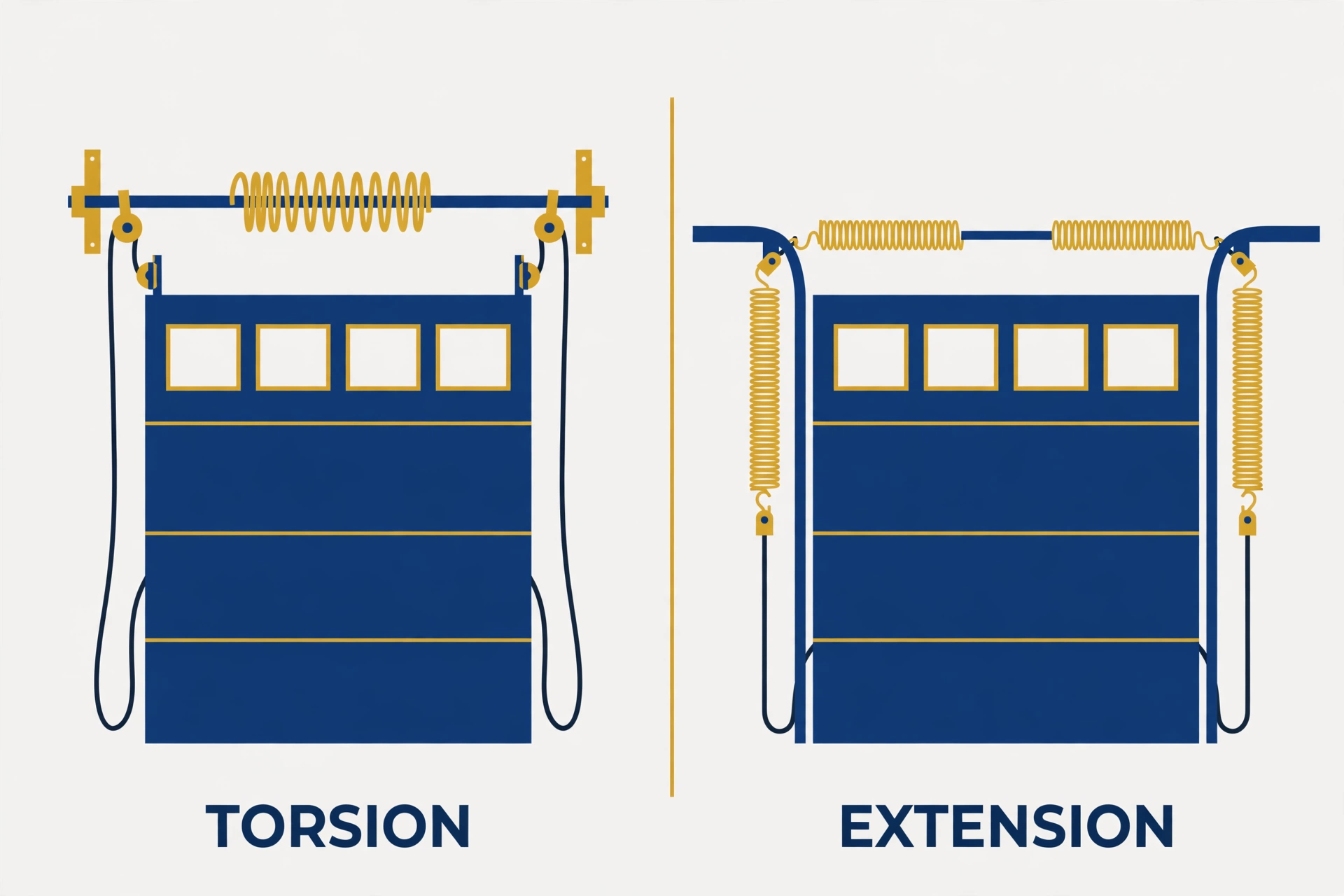
Torsion springs are one or two tightly wound coils mounted on a horizontal metal shaft, the torsion bar, directly above the door opening. As the door closes, cables wind the springs tight, storing energy; as it opens, the springs unwind and lift the door. Manufacturers describe torsion as the more durable system, and it is the standard on most doors installed in the last two decades. It lifts more smoothly than extension, keeps both sides of the door synchronized, and stays contained on its shaft if it breaks, which makes a torsion failure less dangerous than a loose extension spring. Torsion also handles heavy insulated and wooden doors well, which is why it is the usual choice on double-car and insulated doors.
Extension springs: the springs along the tracks
Extension springs are long, lighter coils that run parallel to the horizontal tracks, one on each side above the door. They stretch as the door closes and contract as it opens, pulling the door up through pulleys and cables. They cost less up front and are common on older homes and some lighter single-car doors, but they shake more in operation, last fewer cycles at the same rating, and come with a safety rule torsion does not need: a containment cable, usually called a safety cable, must run through each extension spring. Industry guidance from DASMA, the door and access systems trade group, is that an extension spring door must never run without one, because a broken extension spring without a cable can whip across the garage. If your extension springs have no cable running through them, that is a safety gap worth fixing before anything else.
How to tell which type your door uses
Stand inside the garage with the door closed and look above the opening. A bar with one or two coils across the top means torsion. Long springs running back along the side tracks mean extension. That check needs nothing more than your eyes: do not poke, pull, or try to adjust either type, because both hold enormous tension even when the door is still. One exception to the visual rule is an enclosed torsion system, where the spring sits inside a tube on the shaft, so you may see a tube rather than an exposed coil. If you cannot tell from looking, a photo of the area above the door is enough for a technician to identify the system. You can read more about what each system feels like when it fails in our signs-your-door-needs-repair guide.
Cycle ratings: how spring life is really measured
Springs are not rated in years; they are rated in cycles, and one cycle is a single opening plus a closing. Manufacturers such as Clopay and Amarr rate standard residential springs at about 10,000 cycles, which works out to roughly seven years at four uses a day, or longer for a door used once a day and shorter for a door used as the family's front entrance. High-cycle springs are sold at ratings around 20,000 cycles and, from some suppliers, 27,000 and 54,000 cycles, using thicker, longer wire so each trip carries less stress. The arithmetic is simple: rating divided by daily cycles, divided by 365, gives the expected years. That is why two identical springs can last very different times in two homes, and why a technician asks how often you use the door before choosing a rating. A spring near the end of its rating can fail without warning, which is why the yearly tune-up matters.
Why weight-matching matters more than the spring's price
A spring is not a generic part. It is wound to a specific wire size, coil count, and length for a specific door weight, and getting that match wrong causes problems in both directions. A spring sized for a lighter door cannot hold yours up, so the door feels heavy, the opener strains, and the gears wear early. A spring sized for a heavier door over-lifts, so the door jumps, slams, or will not stay closed. Weight-matching is also why both springs on a two-spring door are replaced together: the pair has shared every cycle, so the unbroken spring is nearly as worn as the broken one, and a new spring paired with a tired one lifts unevenly. When a technician replaces springs, the job starts with the door's weight and your daily use, not with the cheapest spring on the shelf. For how that replacement is carried out, see garage door spring replacement.
Signs each spring type is failing
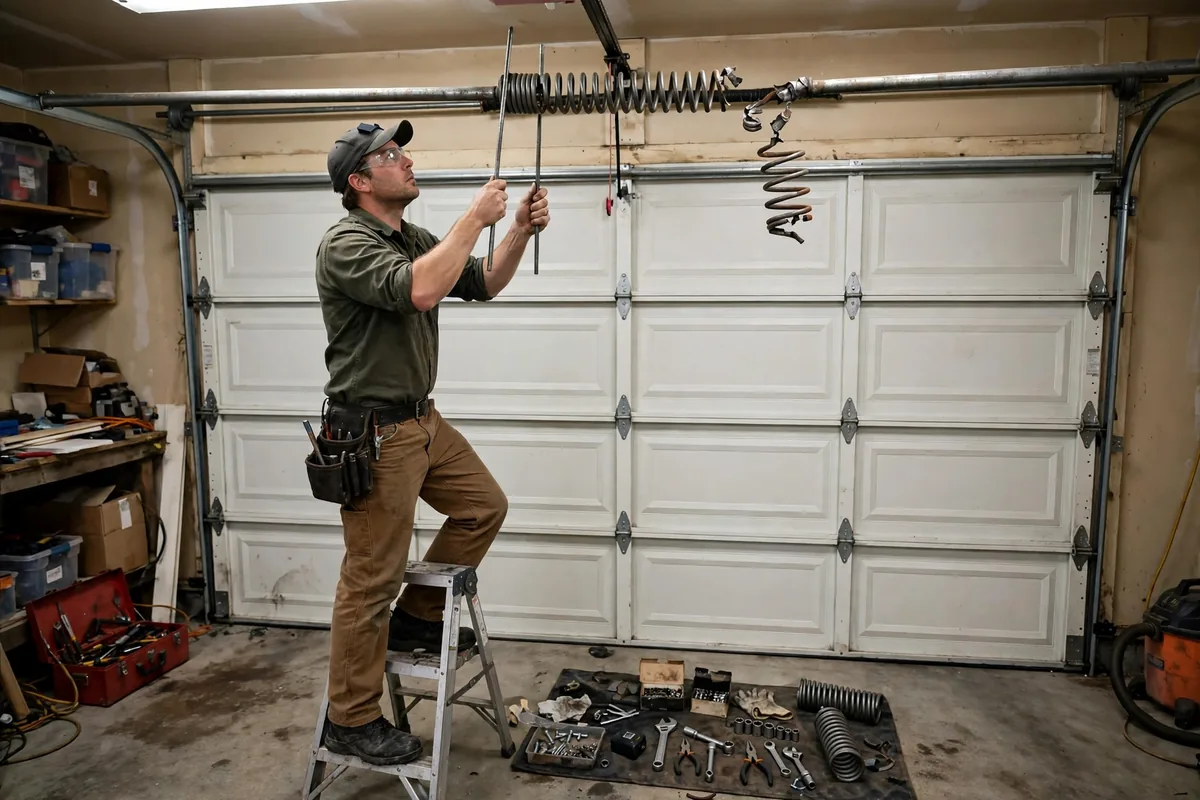
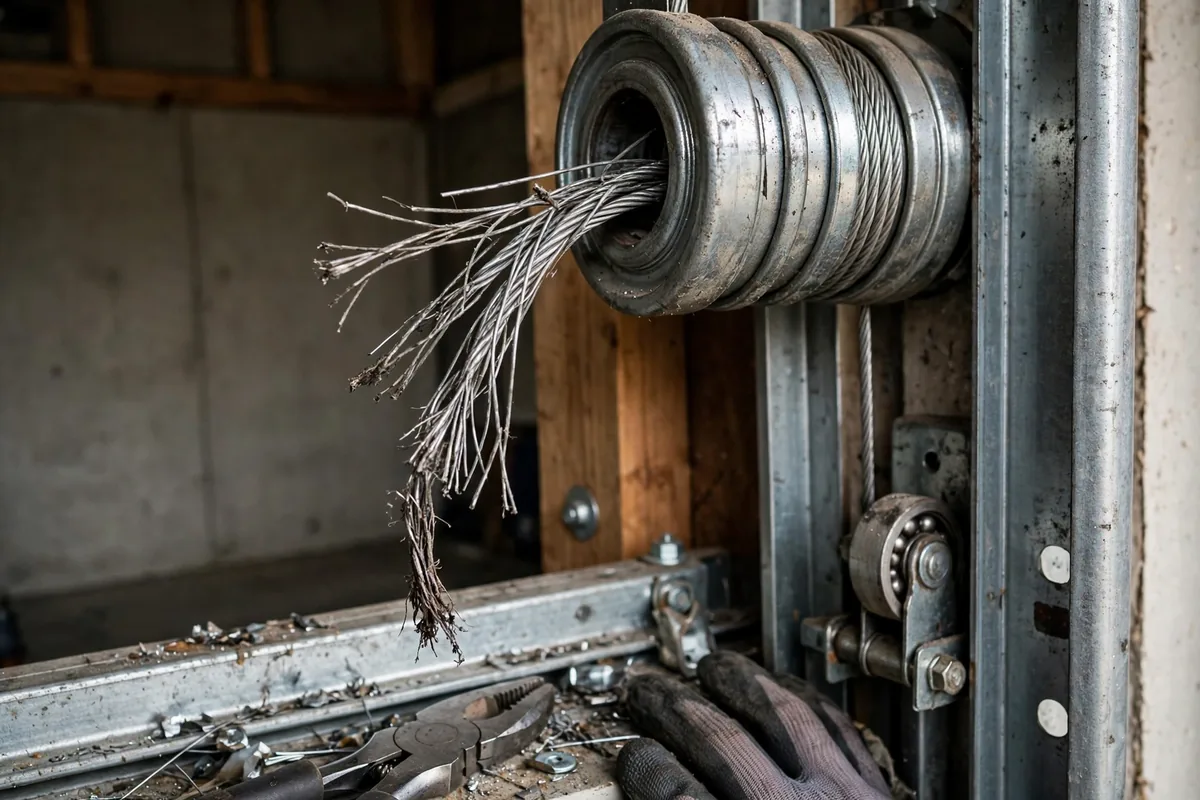
Torsion failure is usually dramatic: a loud bang from the garage, then a door that will barely lift, often with a visible gap in the coil where the spring snapped. Extension failure is quieter and easier to miss: the springs look stretched out or sagging, the door hangs crooked because one side is pulling harder, or the door feels heavier than it did last month. Either way, the safe response is the same. Do not keep forcing the door, do not try to prop it open, and do not touch the springs, cables, or bottom brackets. Spring work is pro-only, full stop: a wound spring stores enough energy to lift a door weighing hundreds of pounds, and an uncontrolled release causes serious injury. Call, describe the symptom, and let a technician bring the right weight-matched springs. The same pro-only rule applies to cables and track work, which is why our maintenance checklist keeps all three off the homeowner list.
Which system suits which door
As a general rule, torsion suits the doors most Massachusetts homes have today: double-car doors, insulated doors, and heavier wooden doors, because it lifts smoothly, stays synchronized across the full width, and lasts longer at the same rating. Extension suits lighter single-car doors, especially older ones where the system is already in place and working well with its safety cables intact. Headroom and track layout also shape the choice: torsion needs room for the shaft above the opening, while extension needs clear track runs on each side. Whether a door can move from one system to the other is a technician's call, based on headroom, track layout, and door weight, and it is not a decision to make from a catalogue listing. What matters most is not which system sounds better in theory, but which one is correctly matched to your door's weight and use, fitted with its safety parts intact, and balanced after fitting.
What a technician checks before choosing your springs
A spring visit is a measurement visit before it is a replacement visit. The technician weighs the door, checks its balance with the opener disconnected, inspects the lift cables, drums, and bottom brackets for wear, and confirms whether extension safety cables are present and intact. Only then is a spring chosen, matched to the door's weight and to how often you use it, with a cycle rating that fits a busy household rather than a bare-minimum one. After fitting, the door is balanced and tested through full travel, and the opener force is set to the door's actual weight, not cranked up to mask a heavy door. That sequence is the difference between a spring that lasts its rated cycles and one that fails early, and it is the same sequence behind the tune-up and cable services on this site.
Garage door repair work
Ready for help? Call (833) 563-1552, Monday to Saturday, 9:00 AM to 6:00 PM, and describe the problem.
Call (833) 563-1552For local help, start from our Bay State Garage Door Repair Pros homepage, see our pages for garage door repair in Lowell and garage door repair in Worcester, and read Garage Door Maintenance Checklist next.
Frequently asked questions about garage door spring types
How do I tell whether my garage door has torsion or extension springs?
With the door closed, look above it from inside the garage. A spring or two wound around a horizontal metal bar across the top of the opening means torsion springs. Long springs running back along the horizontal tracks on each side mean extension springs. Looking is safe; touching, loosening, or adjusting either type is not.
How long do garage door springs last?
Manufacturers such as Clopay and Amarr rate standard residential springs at about 10,000 open-and-close cycles, roughly seven years at four uses a day. A cycle is one opening plus one closing, so a household that uses the door more often wears springs out faster. High-cycle springs rated at 20,000 cycles or more are available for busy doors.
Why must a replacement spring match my door's weight?
A spring counterbalances the door's actual weight, so a spring sized for a lighter door cannot hold yours up, and one sized for a heavier door over-lifts it. Either mismatch strains the opener, wears parts faster, and makes the door heavy or jumpy. A technician weighs the door and matches the spring to that weight and to your daily use.
What are the signs a garage door spring is failing?
A loud bang from the garage, a visible gap in a torsion spring coil, a door that feels much heavier by hand, a door that hangs crooked, or extension springs that look stretched out or sagging. Any of these means the spring system needs a technician, not another lift attempt, because the remaining parts are carrying extra load.
Should both springs be replaced when only one breaks?
Yes, when the door has two springs. Both have lived through the same number of cycles and carry the same wear, so the second is usually close behind the first. Replacing the pair together keeps both sides lifting evenly and avoids a second breakdown and a second visit soon after.