
Garage Door Opener Types Explained
This garage door opener types guide compares chain, belt, screw, and jackshaft drives for Massachusetts homes: noise, durability, horsepower matching, smart features, ceiling space, attached vs detached garages, plus safety sensors and battery backup, and what to check before replacing an opener.
Chain, belt, screw, and jackshaft openers all move the same door, but they differ sharply in noise, durability, and price. The springs do the lifting, so the right opener starts with a balanced door and the right horsepower.
First, the fact that decides everything: the springs lift, the opener finishes
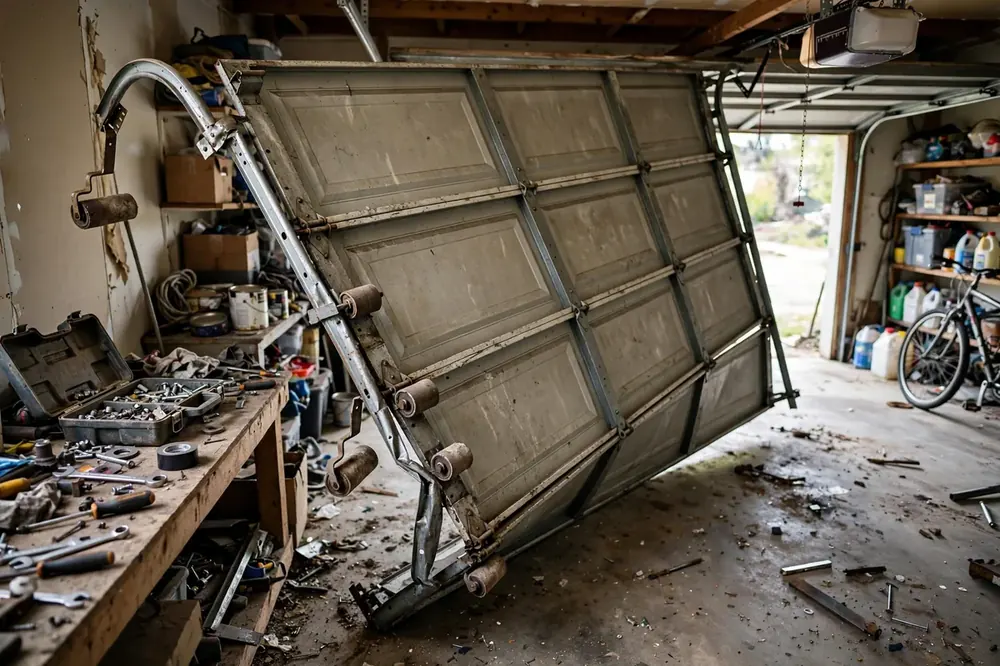
Every opener guide has to start here, because it changes how you shop. A garage door opener does not lift your door. The springs counterbalance the door's weight, and the opener only supplies the last part of the effort and holds the door where it stops. A door with a worn spring will strain even the best opener, and a new opener fitted to an unbalanced door will wear out early. So before comparing drive types, know that any honest opener quote starts with a balance and spring check. With that settled, the choice comes down to four drive types, the right horsepower for your door, and the features you actually want.
Chain drive: the cheapest, the toughest, the loudest
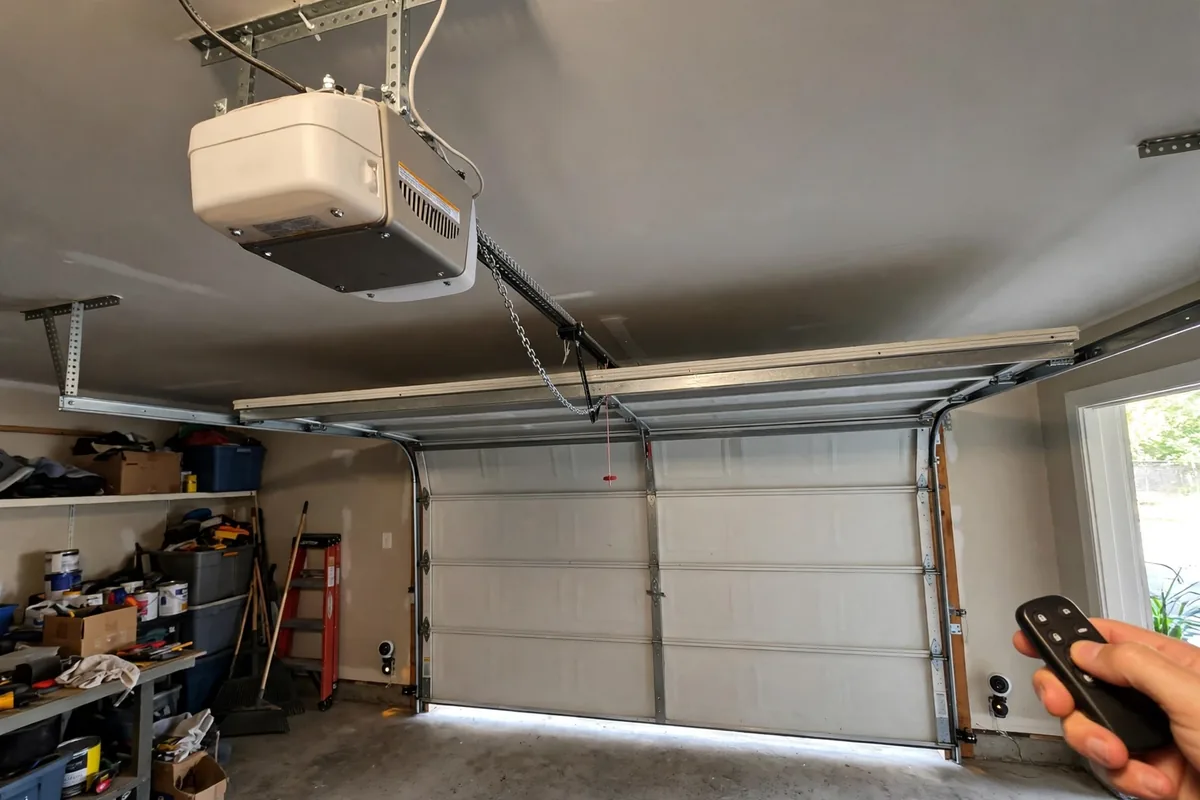
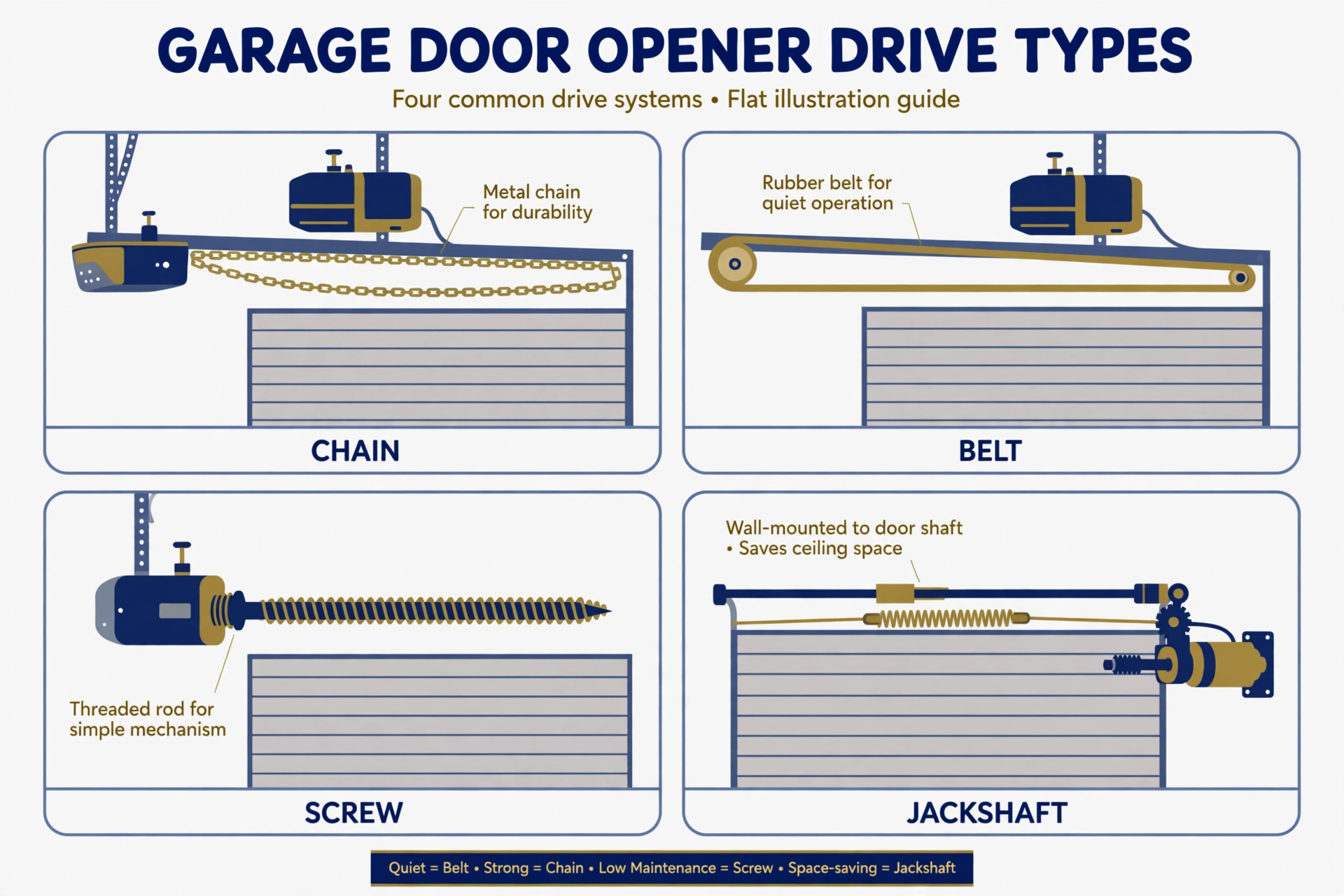
A chain-drive opener pulls a trolley along a ceiling rail with a metal chain, much like a bicycle chain. It is the cheapest drive type, the most durable in the trade's general experience, and the loudest, which is why it suits a detached garage or a garage with no living space above or beside it. Chain drives handle heavy doors well and have the longest track record of any drive, but the chain rattles on every trip, and that noise travels through ceilings and shared walls. If your garage is attached and a bedroom sits above it, the money saved on a chain drive is usually spent again in annoyance. Chain drives also need occasional chain tension attention, a small job that belongs on a tune-up visit.
Belt drive: the quiet choice for attached garages
A belt-drive opener works exactly like a chain drive, except a reinforced rubber belt replaces the metal chain. That one change removes most of the rattling, making belt drive the quietest ceiling-mounted type and the usual recommendation for an attached garage or any home with a bedroom above the garage. Belt drives cost more than an equivalent chain drive, roughly a third to a half more at the same horsepower according to dealer comparisons, but they run smoother and need less attention to tension. For most attached-garage homes, a belt drive with Wi-Fi and battery backup is the sweet spot dealers keep returning to: quiet, reliable, and no harder to live with than a chain unit.
Screw drive: few parts, mid-range noise, fading from the market
A screw-drive opener turns a threaded steel rod along the rail, and the trolley travels along the threads. It has fewer moving parts than chain or belt drives, which means less to wear out, and its noise sits between chain and belt. The trade-offs are real, though. The rod wants to stay greased, temperature swings can change how smoothly it runs, and screw drives are far less common in current production than they once were, which can make parts harder to find. Screw drive still suits a one-piece door or a homeowner who values mechanical simplicity, but for most sectional doors today the choice is really between chain, belt, and jackshaft.
Jackshaft, or wall-mount: no ceiling rail at all
A jackshaft opener, also called a wall-mount or side-mount opener, bolts to the wall beside the door and drives the torsion shaft directly, with no motor hanging from the ceiling and no rail running across it. That frees the whole ceiling for storage racks, a car lift, or a high-lift or cathedral-ceiling layout, and it runs very quietly. The conditions matter: a jackshaft needs a torsion spring system, because it drives the torsion shaft, plus enough side room beside the door to fit the unit. It costs more than a ceiling-mounted unit at the same horsepower, and it will not suit an extension-spring door. If your ceiling space is the reason you are shopping, jackshaft is the answer; if your ceiling is free, a belt drive gives you the same quiet for less money. For fitting, see garage door opener installation.
Horsepower and size matching: strain matters more than lifting power
Horsepower guidance from dealers is consistent. A lighter single-car steel or aluminium door usually runs fine on a half-horsepower opener. An insulated steel or double-car door generally wants three-quarter horsepower. A solid wood, oversized, or heavily insulated door wants one horsepower or more. The number is less about raw lifting power than about the strain the motor takes on every cycle: an underpowered opener on a heavy door runs hot, gets noisy, and strips its gears years early, while a correctly sized motor runs cooler and lasts longer under the same load. Modern openers often use DC motors, so the headline horsepower figure is not always directly comparable between models, but the principle holds: match the motor to the door's weight and size, and fix the springs first if the door is heavy. If your current opener is already struggling, see garage door opener repair before assuming the opener itself is the problem.
Smart features, remotes, keypads, and battery backup
Smart, or Wi-Fi, openers add phone control, open-or-closed alerts, and remote access, through systems such as LiftMaster myQ, Chamberlain Smart, or Genie Aladdin Connect, depending on the brand. Those features are conveniences, not lifting improvements: a smart chain drive is still a loud chain drive. Battery backup keeps the opener working during a power cut, which matters in a Massachusetts winter storm, and some states now require it on new openers, though Massachusetts buyers should treat it as a feature choice rather than a legal claim on this page. Remotes and keypads are the everyday controls, and a shortening remote range usually means batteries before it means a failing opener. When choosing, pick the drive type and horsepower first, then add the smart and backup features you will actually use.
Safety sensors: the brief version
Every modern opener works with a pair of photo-eye safety sensors near the floor on each side of the door, plus an auto-reverse system built to the UL 325 safety standard. If the beam between the sensors is broken while the door is closing, the door reverses; if the door hits an obstruction, the force sensor reverses it too. The homeowner's part is small and important: keep the lenses clean and the doorway clear, because a dirty lens is one of the most common reasons a door reverses or refuses to close. Sensor alignment, force settings, and auto-reverse testing belong to a technician, and sensors get a full guide of their own in this series. Never test the safety reverse by standing in the doorway.
When the opener type no longer suits the door
Openers are often bought once and forgotten, but the door and the garage around them change. A light single door replaced with a heavier insulated double door needs more horsepower than the old opener offered. A bedroom built above a previously detached-feeling garage turns a loud chain drive into a nightly annoyance. A ceiling once empty, now wanted for storage racks or a car lift, makes a jackshaft worth its premium. In each case the fix is not a stronger remote or a louder motor setting; it is revisiting the drive type and horsepower against the door as it is now, with the springs and balance checked first. An opener that suited the old door can be the wrong opener for the new one, and that mismatch shows up as noise, strain, and early gear wear long before it shows up as a breakdown.
How to choose for your door type
Start with where the garage sits. Detached, or no living space nearby: a chain drive is the best value and will last. Attached, or a bedroom above or beside the garage: a belt drive, or a jackshaft if the ceiling matters. Then match horsepower to the door: half for a light single, three-quarter for an insulated or double door, one or more for wood or oversized doors. Then check the spring system: jackshaft needs torsion springs and side room, while chain and belt work with either system. Finally, add smart control and battery backup if you want them, and budget for the spring and balance check that should come first. A door that is balanced, on matched springs, with a correctly sized opener of the right drive type is a door that runs quietly for years; a door that skips any of those steps is a door you will hear about.
Garage door repair work
Ready for help? Call (833) 563-1552, Monday to Saturday, 9:00 AM to 6:00 PM, and describe the problem.
Call (833) 563-1552For local help, start from our Bay State Garage Door Repair Pros homepage, see our pages for garage door repair in Lowell and garage door repair in Cambridge, and read Garage Door Maintenance Checklist next.
Frequently asked questions about garage door opener types
Which garage door opener type is quietest?
A belt-drive opener is the quietest ceiling-mounted type, because a reinforced rubber belt replaces the metal chain and removes most of the rattling. A wall-mounted jackshaft opener is quieter still, since it has no ceiling rail at all. Either is the right choice when a bedroom sits above or beside the garage.
What horsepower opener does my garage door need?
A lighter single-car steel or aluminium door usually runs fine on a half-horsepower opener. An insulated steel or double-car door generally wants three-quarter horsepower, and a solid wood, oversized, or heavily insulated door wants one horsepower or more. The point is motor strain: an underpowered opener on a heavy door runs hot and strips its gears years early.
Can a jackshaft opener fit any garage door?
No. A jackshaft, or wall-mount, opener drives the torsion shaft directly, so it needs a torsion spring system, enough side room beside the door, and a suitable track setup. It will not suit an extension-spring door or a garage with no wall clearance, which is why the spring system is checked before a jackshaft is quoted.
Do I need a smart or Wi-Fi garage door opener?
You need it only if you want phone control, open-or-closed alerts, and remote access for deliveries or family. A smart opener does not lift better than a standard one; the drive type and horsepower decide that. Wi-Fi, battery backup, and camera features are conveniences layered on top of the drive, not replacements for it.
Why does my opener struggle if the springs are worn?
Because the springs do the lifting and the opener only finishes the job. A worn or broken spring leaves the opener hauling the door's full weight, which strains the motor, strips gears, and can burn the opener out. That is why balance and springs are checked before any opener is replaced or quoted.