
Commercial Garage Door Types Explained
Commercial garage doors come in sectional, rolling steel, high-cycle, high-speed, and fire-rated types — and the right one depends on cycles, headroom, security, and fire plan. This guide compares them so you can choose by workload, not by price alone.
A commercial garage door is chosen by workload, not by size alone: sectional doors suit warehouses and service bays, rolling steel suits tight headroom and security, high-cycle hardware suits busy docks, and fire-rated doors suit openings a fire plan requires. Count your daily cycles before you choose.
Commercial doors are not just bigger residential doors
A commercial garage door looks like a scaled-up home door, but it is built for a different job. Residential doors are typically cycled a few times a day; a warehouse dock door, a service bay, or a distribution opening may cycle dozens or hundreds of times daily, carry forklifts and trucks through a wider and taller opening, and keep running through weather and dust that would wear a home door out in months. That is why commercial doors use heavier-gauge steel, reinforced hardware, higher cycle ratings, and openers sized for the door's actual weight and workload — and why choosing the wrong type costs more in downtime than it saves on purchase price.
This guide covers the main commercial door types, what each one suits, and what drives the choice. It is a buying guide, not a repair manual: for faults on an existing door, see commercial garage door repair, and for fitting a new door, see new door installation. No business, contract, or case study is claimed here — the examples are building types, not customers.
Sectional commercial doors: the warehouse and service-bay standard
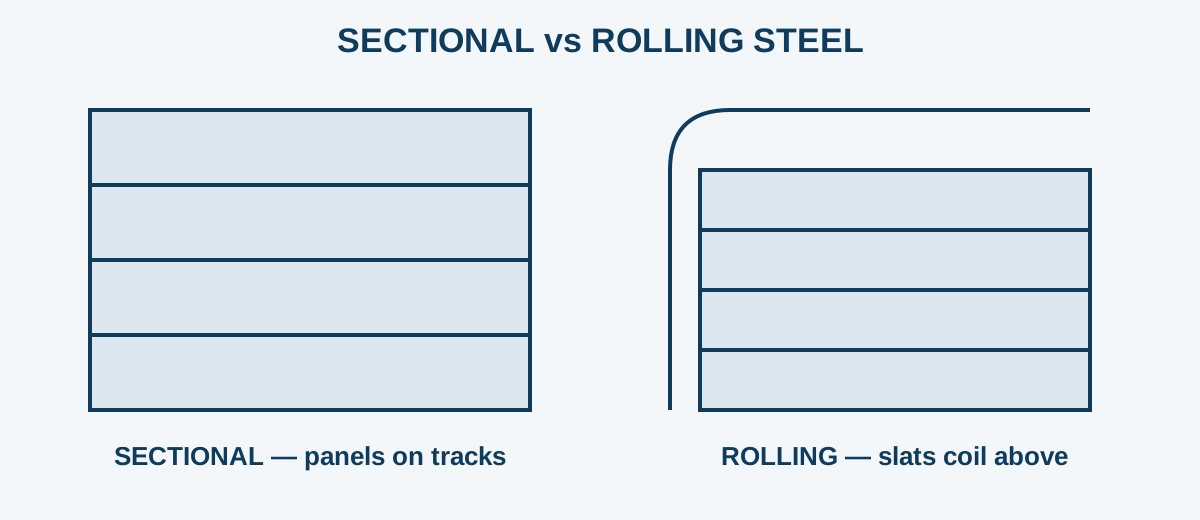
A sectional commercial door is made of horizontal panels joined by hinges, travelling along vertical and horizontal tracks so the open door rests flat under the ceiling. It is the most common commercial type for warehouses, service centres, and industrial buildings, and the reasons are practical: panels can be insulated, windows and personnel doors can be built in, damaged panels can be replaced individually, and the door seals reasonably well against weather and dust.
The trade-off is space. A sectional door needs headroom above the opening for the horizontal tracks and backroom — the distance from the opening to the back wall — for the open door to sit in. Low-headroom buildings, or openings with obstructions above them, may not suit a sectional door at all, which is where rolling steel comes in. Sectional doors also have more moving parts — hinges, rollers, and track sections — so a high-cycle opening needs those parts specified at a higher rating from the start, not upgraded after they wear.
Rolling steel doors: security and space-saving in a coil
A rolling steel door, also called a coiling door, is made of interlocking metal slats that roll up into a compact coil above the opening. Because the door coils rather than lying flat, it needs far less headroom and backroom than a sectional door, which makes it the usual choice for storefronts, storage facilities, and industrial openings where ceiling space is tight or already used by racking, cranes, or ductwork.
Rolling steel is also the security-first choice: a continuous curtain of steel slats with no panel joints to pry is harder to force than a panelled door, and the slats can be specified in heavier gauges for higher-security openings. The trade-offs are insulation and repair access. A plain steel curtain insulates poorly compared with an insulated sectional panel, so a heated warehouse may need insulated slats or a different type altogether, and a damaged slat section is a more involved repair than swapping one sectional panel. Sheet doors — the lighter, single-skin roll-up doors common on self-storage units and light commercial buildings — sit at the economy end of this family: cheaper and simpler, but not built for heavy or high-cycle use.
High-cycle and high-speed doors: when the workload decides the door
Cycle rating is the number most buyers overlook and the one that matters most for a busy opening. A cycle is one full open and close. Standard residential hardware is typically rated around ten thousand cycles; commercial hardware is rated far higher, and high-cycle springs, rollers, and openers are specified for openings that cycle constantly. A loading dock door opened fifty times a day will burn through standard hardware in months, while the same door on high-cycle parts lasts years — the purchase price difference is small next to the cost of repeated breakdowns and a door stuck shut during deliveries.
High-speed doors are a separate category: doors built to open and close far faster than a standard door, used in manufacturing, logistics, and food or pharmaceutical facilities where an opening must spend as little time open as possible — for temperature control, dust control, or traffic flow. They use lighter, flexible curtains and powerful operators, and they trade some security and insulation for speed. If your opening is a bottleneck where every second of open time costs money or climate control, high-speed is worth pricing; if it opens a few times a day, it is an unnecessary expense.
Fire-rated doors, dock doors, and what FDDT means
Fire-rated commercial doors are built to hold back fire and smoke for a rated period, using flame-resistant materials and self-closing mechanisms that shut the door automatically when a fire alarm or fusible link trips. They are used where a building's fire separation plan requires them — openings between fire compartments, or between a warehouse and an office block — and whether your opening needs one depends on the building code and the fire plan for your premises, not on the door type alone. A fire-rated door is not simply a heavier rolling door: its rating, its closing mechanism, and its testing regime are part of the fire system, and its drop test must be carried out by someone qualified to do it.
That qualification has a name worth knowing: Fire Door Drop Test (FDDT) certification. It is listed here only as a credential name — this guide does not claim a fire-door installation service, and a fire door's rating and testing should always be confirmed with the building's fire plan before any work is specified. Dock and warehouse doors add their own considerations on top of the type choice: dock levellers and seals, bumper protection against forklift strikes, wind loading on large openings, and opener power matched to the door's weight and cycle count. A door that is perfect on paper but unprotected from forklift traffic will not stay perfect for long.
Choosing the right commercial door: five questions to ask first
One, how many cycles a day? Count honestly, including deliveries, shift changes, and waste collection — the cycle count decides the hardware rating. Two, how much headroom and backroom does the opening actually have? Measure, don't guess: it rules sectional doors in or out immediately. Three, does the opening need insulation, security, speed, or fire rating most? No single door type leads on all four, so rank them. Four, what hits the door? Forklifts, trucks, and trolleys argue for heavier slats or panels and bumper protection. Five, what does the building code and fire plan require for this opening? That answer can override every other preference, and it must come before a door is ordered.
Price follows those answers. Commercial pricing depends on door size, door type, insulation, cycle rating, opener power, and special features such as high-speed operation or fire rating, so it is quoted by factors and a call rather than a single published figure — the exact price is confirmed on site before work starts. Bring the five answers to that call: opening size, daily cycles, headroom, priorities, and any fire-plan requirement. A supplier who can quote without them is guessing, and a commercial door is too expensive a mistake to guess on.
Garage door repair work
Ready for help? Call (833) 563-1552, Monday to Saturday, 9:00 AM to 6:00 PM, and describe the problem.
Call (833) 563-1552For local help, start from our Bay State Garage Door Repair Pros homepage, see our pages for garage door repair in Lowell and garage door repair in Worcester, and read Garage Door Maintenance Checklist next.
Frequently asked questions about commercial garage door types
What is the difference between a sectional and a rolling steel commercial door?
A sectional door is made of horizontal panels joined by hinges that travel along tracks and rest flat under the ceiling when open. A rolling steel door is made of metal slats that coil into a compact roll above the opening, needing less headroom and backroom but usually offering less insulation.
How do I know if my business needs a high-cycle door?
Count daily cycles. A door opened a handful of times a day can use standard hardware, but a loading dock or distribution opening cycled dozens or hundreds of times daily needs high-cycle springs, rollers, and openers rated for that workload, or it will wear out far sooner than expected.
Are fire-rated commercial doors required for every business?
No. Fire-rated doors are used where a building's fire separation plan requires them, such as openings between fire compartments. Whether your opening needs one depends on the building code and the fire plan for your premises, not on the door type alone — ask before assuming.
What drives the price of a commercial garage door?
Size, door type, insulation, cycle rating, opener power, and any special features such as high-speed operation or fire rating. Because commercial openings vary so widely, pricing is by factors and a call, not a single published figure — the exact price is confirmed on site before work starts.
Can a commercial door be repaired, or does a worn door need replacing?
Most worn commercial doors can be repaired — springs, cables, rollers, and openers are all replaceable parts. Replacement makes sense when panels are badly damaged, the door type no longer suits the workload, or repair costs approach the cost of a door built for the job.