
Broken spring, snapped cable, or off-track door on the East End? Find the fault
If you need garage door repair in East End, New Bedford, MA, start with the symptom and where the door sits. A harbor-side door on Front Street or a low street off East Rodney French Boulevard lives a harder life than an inland door: salt spray, damp slabs, and storm water all reach the bottom of the door first. If the door will not open, will not close, feels too heavy to lift, or hangs crooked, it is usually a broken spring, a snapped cable, or an opener problem. Call (833) 563-1552, describe the symptom, and we will tell you the next step.
We serve New Bedford Monday through Saturday, 9:00 AM to 6:00 PM, and you can also reach us at [email protected]. Our team has 26 years of experience, and the business holds Home Improvement Contractor (HIC) Registration, a Construction Supervisor License (CSL), a Lead-Safe Renovation Contractor License, and IDEA certifications for residential and commercial garage door systems.
The East End is the harbor-facing eastern side of New Bedford, where the city meets the Acushnet River and Buzzards Bay. The port here is a working commercial fishing port, the largest in the United States by value of catch, and the streets closest to the water — around Front Street, the historic waterfront, and East Rodney French Boulevard — take more salt, more damp, and more storm exposure than streets further inland. That changes what goes wrong with garage doors here, and it is why this page is not a copy of the New Bedford city page. For the full city picture, start from our New Bedford garage door repair page, and come back here for East End detail.
Garage door repair in East End, New Bedford: what we fix
East End calls fall into a few clear problems, but the harbor sets the order they arrive in. Bottom brackets and bottom sections rust out first here, cables fray where salt sits on the drum, and opener motors on low streets suffer after water gets in. Knowing which fault you have — and whether water has ever reached your garage floor — helps us bring the right part on the first visit. We check the whole system on every visit — springs, cables, rollers, tracks, and opener — because on a harbor-side door these parts wear together. See the full garage door services we offer for detail on each job, and start from our Bay State Garage Door Repair Pros homepage for the statewide picture.
Broken springs — the job you should not try yourself
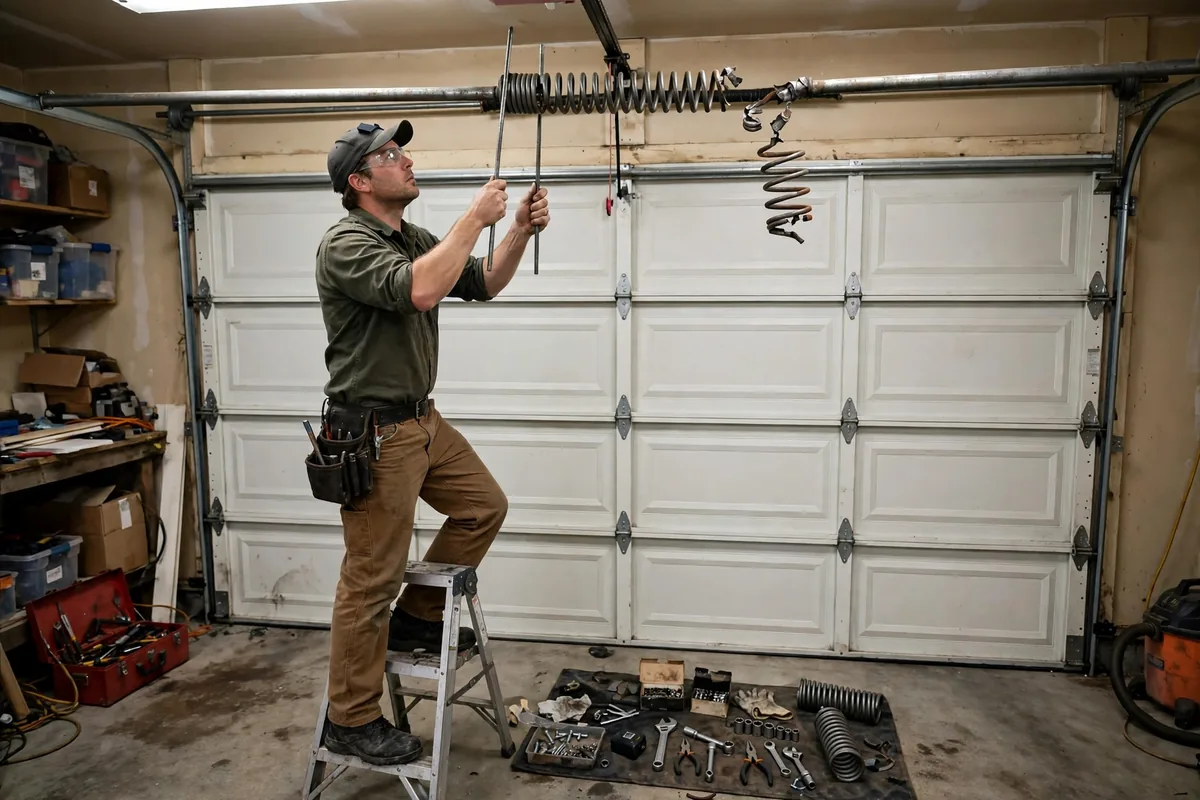
A torsion spring sits above the door. An extension spring runs along each side track. When one breaks, you may hear a loud bang, see a gap in the coil, or find the door far too heavy to lift. Springs balance the door's weight, so when a spring breaks, the full weight falls back on the door and the opener. Do not pull the emergency release cord and try to lift a door with a broken spring. Leave it closed and call us. We match a new spring to your door's weight and size, replace it, and test the balance before we leave. That matching step matters on the East End, where a heavier waterfront commercial door and a lighter triple-decker house door need very different springs. For the full spring service, see our garage door spring replacement service.
Cables, rollers, tracks, and panels
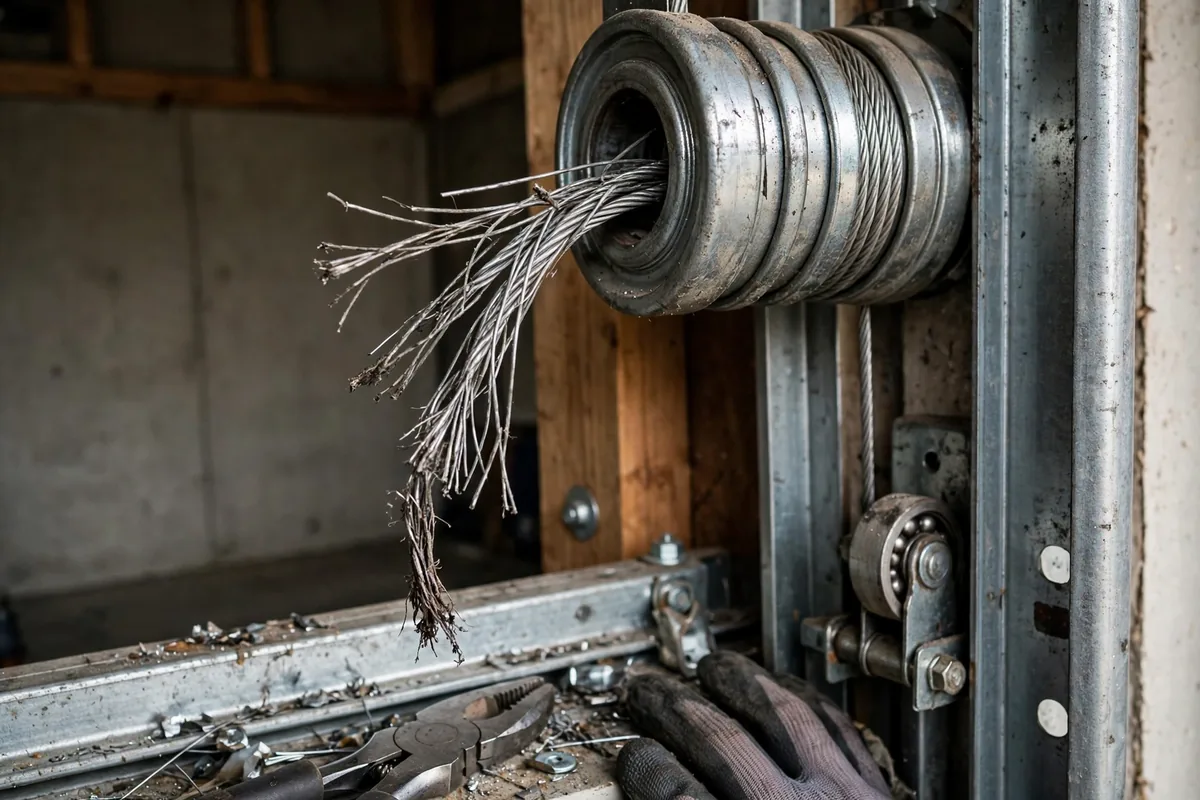
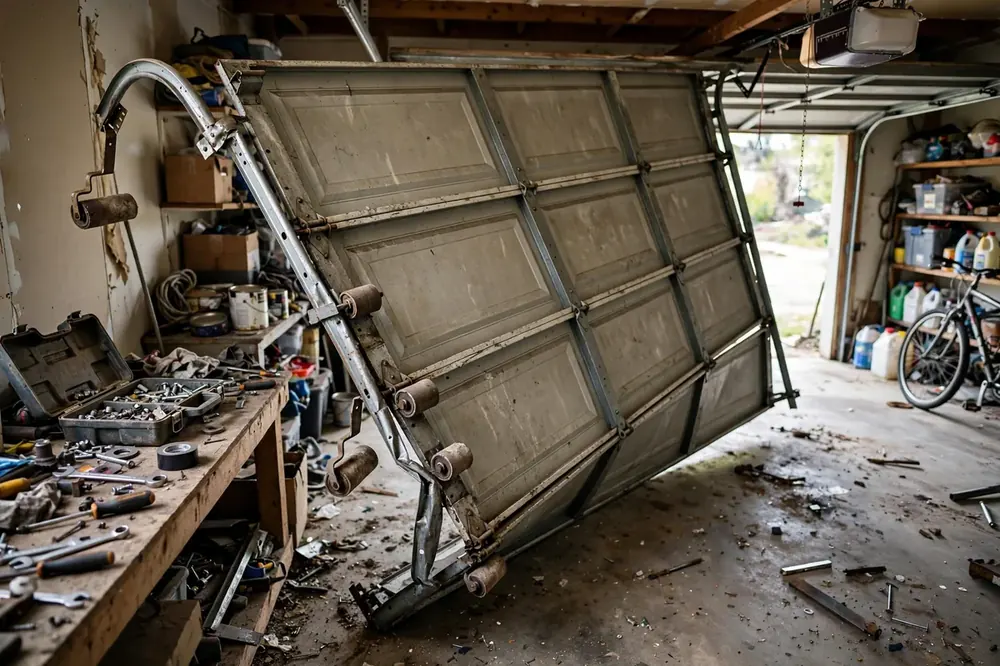
Cables work with the springs. When a cable frays or snaps, one side of the door can drop, which is why our garage door cable repair service checks the cable, drum, and spring together, not just the snapped part. Worn rollers and bent tracks cause many slow, noisy doors, and on the East End the bottom of the door deserves the closest look: salt air rusts bottom brackets and bottom sections first, and a rusted bottom bracket under spring tension is a safety problem, not a cosmetic one. If the door scrapes, sticks halfway, or leans to one side, stop using the opener, or you can bend the track further and damage a panel.
- Cables: frayed, loose, or snapped — stop using the door, and tell us if the cable looks rusted at the drum.
- Rollers and hinges: worn, cracked, or loose — often the cause of grinding and jerking on a salt-exposed door.
- Tracks: bent, misaligned, or rusted at the bottom — common where salt and damp sit on an old harbor-side slab.
- Panels: dented or rusted at the bottom — one section can often be replaced, but the new panel must match the door's weight and balance.
A single dented panel does not always mean a new door. In many cases, one panel section can be replaced. But if the track, framing, or several panels are failing at once — or the bottom section is rusted through from harbor damp — replacement may cost less in the long run. We will tell you honestly on site which path makes sense for your door.
Opener repair
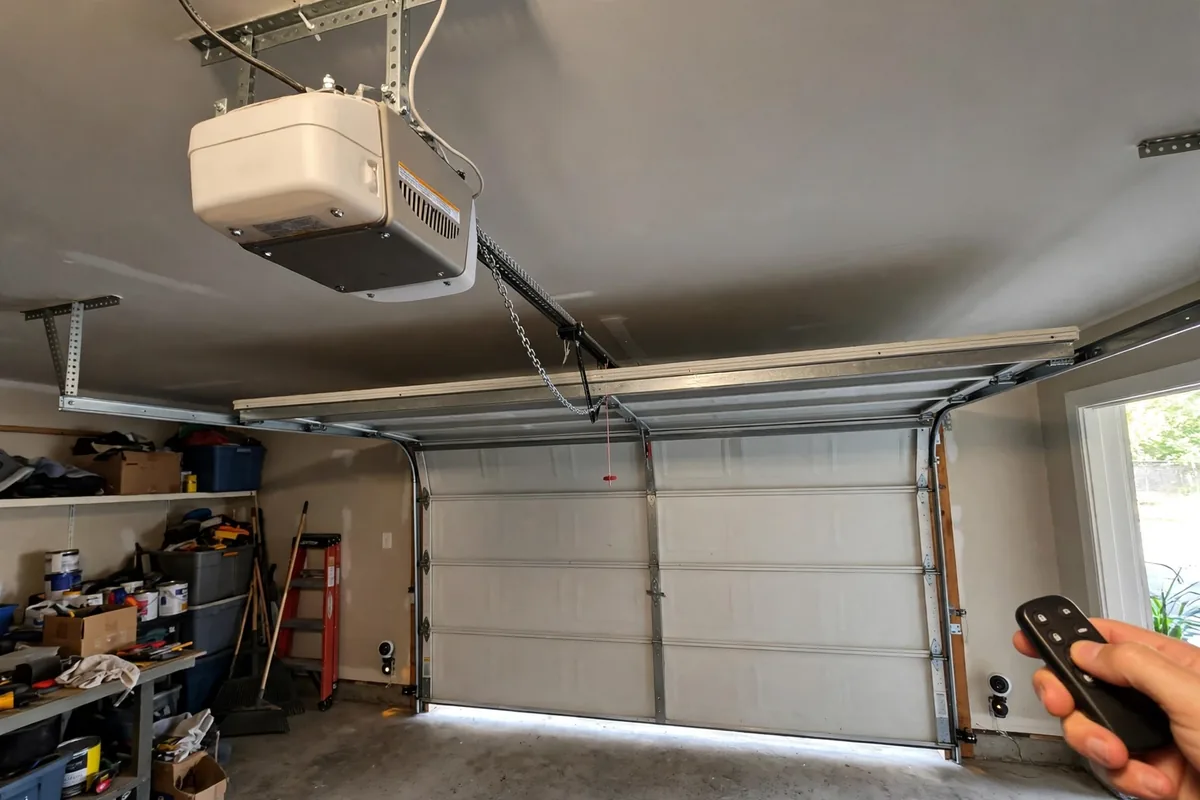
Opener problems are often simpler than they look. First, check that the opener has power and that nothing blocks the small photo-eye sensors near the floor. Next, check the remote battery and whether the emergency release cord was pulled by accident. However, if the opener hums, grinds, or runs without moving the door, that points to a gear, belt, chain, or board problem inside the opener. Our garage door opener repair service starts with diagnosis, not a new opener quote. On low harbor-side streets, tell us if water has ever reached the garage floor: a motor or sensor that has been wet needs checking even if it still runs.
How much does garage door repair cost in East End, New Bedford, MA?
There is no single price for every door, because cost depends on what broke, the door's size and weight, and the part needed. For that reason, we give you an exact price on site before work starts, not a guess over the phone. The table below shows planning ranges reported by other Massachusetts sources. These are not Bay State prices, and your exact price will depend on your door — including whether harbor rust has spread beyond the one failed part.
| Repair | Planning range reported by other sources | Usual time on site (competitor-reported) |
|---|---|---|
| Most common residential repairs | $150 to $400 | 1–2 hours |
| Single torsion spring replacement | $200 to $350 | 1–2 hours |
| Spring or cable replacement (broader range) | $200 to $500 | 1–2 hours |
| Cable repair / replacement | $150 to $250 | About 1 hour |
| Roller replacement (set) | $120 to $220 | About 1 hour |
| Opener repair | $150 to $400 | 1–2 hours |
| Off-track / track repair | $150 to $300 | 1–2 hours |
| Panel replacement, per panel | $250 to $600 | 1–3 hours |
| Tune-up / maintenance | $85 to $150 | 45–90 minutes |
Ranges differ because of door weight, spring cycle rating, and whether one spring or a pair is replaced — and on the East End, because a rusted bottom section or a water-damaged opener can widen the job. We confirm your exact price on site before work starts.
What changes your price most?
- Door weight and size: a heavier double-car or insulated door costs more than a light single-car door, and a waterfront commercial door costs more again.
- Spring type and cycle rating: a high-cycle spring costs more up front and lasts more open-and-close cycles — the right question for a fishing or marine building door that cycles all day.
- One spring or a pair: when one spring breaks, the other is often close behind. Replacing both can save a second visit.
- Related parts: cables, drums, rollers, or a bent track found during the check can add to the job, and harbor rust often means the bottom hardware goes with them.
- Access: a narrow lot, a shared driveway, or a low harbor-side garage can change the time needed, especially if water has been inside.
Why East End garage doors break: salt air, older stock, and low harbor streets
New Bedford was built on whaling and then on fishing and textiles, and the East End still shows it. The historic district near the waterfront — bounded by Front Street on the east, Elm Street on the north, Acushnet Avenue on the west, and Commercial Street on the south — holds Federal and Greek Revival buildings put up between 1790 and 1855, and the streets around it are a mix of older triple-deckers, converted worker housing, and waterfront commercial buildings. The city's characteristic house form is the wooden triple-decker, often split into flats, and many of those homes have detached garages or shared driveways rather than a modern attached garage.
- Salt air from the harbor: doors closest to the water rust from the bottom up. Bottom brackets, bottom sections, and the lowest hinges go first. Check the bottom of your door twice a year, not just the opener.
- Older, narrower openings: many East End garages were built for smaller cars. Tell us the opening size when you book, so we bring the right parts.
- Shared driveways and narrow lots: a door that cannot open fully because of a fence, a wall, or a neighbor's car gets forced, and forced doors bend tracks.
- Low streets near the water: East Rodney French Boulevard is a low-lying road near the harbor, and the hurricane barrier that has protected the port since 1966 has street gates on East Rodney French Boulevard that close during storm events. If your garage sits on a low street, water reaching the opener motor or sensors is a real risk after storms.
- Commercial doors on the waterfront: fishing and marine buildings use heavier sectional and rolling doors that cycle far more often than a house door. Their springs and openers wear on a different schedule, and they need commercial-rated parts.
None of this means replacing a door early. It means checking the whole system — springs, cables, rollers, tracks, and opener — instead of only swapping the part that made the noise, and checking the bottom of the door first, because that is where the harbor gets in.
An East End tune-up: what to check before winter
Before the cold arrives, walk around your door and check five harbor-side things: the bottom section and bottom brackets for salt rust, the cables for fraying at the drum, the rollers for cracks, the tracks for grit washed in off a low street, and the photo-eye sensors for alignment. Wipe the sensors, clear the tracks, and listen for grinding or jerking on one open-and-close cycle. If the door is heavy, crooked, or noisy in a new way, stop and call — winter cold makes a worn spring more likely to snap on a cold morning, and a door already struggling against salt and damp will not improve on its own. For a full check, book a tune-up and we will test balance, safety sensors, and opener limits on site.
What to tell us when you call from the East End
Five details help us bring the right part on the first visit to an East End address: your opening size, whether the garage is attached or detached and whether it has reliable power, whether the door is stuck open, stuck closed, or crooked, whether you heard a bang or saw a loose cable, and whether water has ever reached the garage floor. If the door is stuck open and your home or car is exposed, say that first — we will advise you on the safest next step for your situation.
ZIP codes and streets we serve on the East End
We serve New Bedford in ZIP codes 02740, 02744, 02745, and 02746. The East End is the harbor-facing eastern side of the city, running from the waterfront and Front Street toward the Acushnet River side, including the East Rodney French Boulevard corridor. We do not assign a single ZIP code to the East End itself, because neighborhood streets cross ZIP boundaries. If you are in one of the four New Bedford ZIP codes above, call us. If you are just outside the East End — in Downtown, the South End, the North End, or Acushnet Heights — call and ask, and we will tell you straight away whether we can help or point you to the right page for your area.
| ZIP code | Area | Note |
|---|---|---|
| 02740 | New Bedford, MA | Paid service ZIP |
| 02744 | New Bedford, MA | Paid service ZIP |
| 02745 | New Bedford, MA | Paid service ZIP |
| 02746 | New Bedford, MA | Paid service ZIP |
Should you fix an East End garage door spring yourself? No — spring tension is dangerous
For a few small things, yes — if it is safe. You can check opener power, clear an obvious blockage from a photo-eye sensor, replace a remote battery, and keep tracks clear of leaves and grit. However, springs and cables are different. Torsion and extension springs hold a large amount of stored energy, and they can cause serious injury if they slip or are wound incorrectly. A simple rule helps: if the door is heavy, crooked, stuck, or making a new loud noise, stop and call. If the door moves smoothly and the problem is a remote, a sensor, or a power issue, try the safe checks first, then call if it does not clear. And after any flooding on a low harbor-side street, do not run the opener until the motor and sensors are dry and checked.
Parts we check on an East End visit
Alongside the main fault, we check the parts that fail next in harbor-side homes: winding bars and shaft alignment on spring jobs, cable drums and bottom brackets (salt rust is common here), hinges, rollers, tracks, panels, weather seals, and opener motors — chain drive, belt drive, and jackshaft — with photo-eye sensors, remotes, and keypads tested before we leave. On a low street we also look for water marks on the motor and sensors.
Other New Bedford neighborhoods we serve include garage door repair in Buttonwood — see that page for neighborhood-specific detail.
Frequently asked questions about garage door repair in East End, New Bedford, MA
How much does garage door repair cost in East End, New Bedford, MA?
Most common repairs in New Bedford are reported in the $150 to $400 range. A single torsion spring is often $200 to $350 installed, cables $150 to $250, and opener repairs $150 to $400 depending on the part. Your exact price depends on your door's size, weight, and the part needed, and we confirm it on site before work starts. Harbor-side doors can sit at different points in that range: a rusted bottom bracket or a motor that has been wet widens the job, which is why the figure is confirmed on site rather than quoted blind.
Does salt air from the harbor damage East End garage doors?
Yes, and it usually starts at the bottom. Doors near the harbor take salt spray and damp air, so the bottom section, bottom brackets, and the lowest hinges rust first — faster on the streets closest to the water around Front Street and East Rodney French Boulevard than further inland. A rusted bottom bracket holds the lift cable under full spring tension, so it is one of the first things we check on a harbor-side visit. Tell us if your door faces the water, and check the bottom of your door twice a year, not just the opener.
My garage is on a low street near East Rodney French Boulevard. Does flooding affect the door?
It can, and the risk is specific to the low ground. Low-lying streets near the harbor sit closer to flood water, and an opener motor, safety sensors, and wiring that sit at floor level are the first parts to suffer after water gets in. The hurricane barrier that has protected the port since 1966 has street gates on East Rodney French Boulevard that close during storm events, but water can still reach a low garage. After any flooding, do not run the opener until the motor and sensors are dry and checked. Call us and describe what the water reached.
Do you repair commercial doors on waterfront properties in East End?
Yes. The harbor side has working waterfront buildings with sectional and rolling commercial doors, and we cover those alongside residential doors. Commercial doors are heavier, cycle more often, and use different springs and openers than a house door — a fishing or marine building door wears on a different schedule from a triple-decker house door. Tell us on the call that it is a commercial door and roughly how wide it is, so we bring commercial-rated parts.
How do I know if my East End street is covered?
We serve New Bedford in ZIP codes 02740, 02744, 02745, and 02746. The East End covers the harbor-facing eastern side of the city, but we do not assign a single ZIP code to the neighborhood itself. Call (833) 563-1552 with your street and ZIP code and we will tell you straight away whether we can help — and if water has ever reached your garage floor, mention that too, because it changes what we check first.
Get help for your East End garage door today
A broken spring, a snapped cable, or a dead opener does not have to mean a day stuck at home. If you are in East End, New Bedford, MA, call Bay State Garage Door Repair Pros at (833) 563-1552, Monday through Saturday, 9:00 AM to 6:00 PM. Describe what your door is doing, and whether water or salt has been at it, and we will give you a clear next step.
Last updated: November 2, 2026. Author: Jude Bray, Bay State Garage Door Repair Pros. Business address: 98-2 Ames Pl, Lowell, MA 01851. Phone: (833) 563-1552. Email: [email protected]. Prices above are planning ranges reported by other Massachusetts sources, not a quote for your door. Your exact price is confirmed on site before work starts. Images and diagrams on this page are illustrations, not photos of real jobs or real staff.